
Written by Grace A.L. Davis
6/11/2026
The Home Office is moving live facial recognition into general immigration enforcement. We went looking for who was reporting it. What we found says almost as much as the policy does.
WHO IS TELLING YOU, AND WHO IS NOT
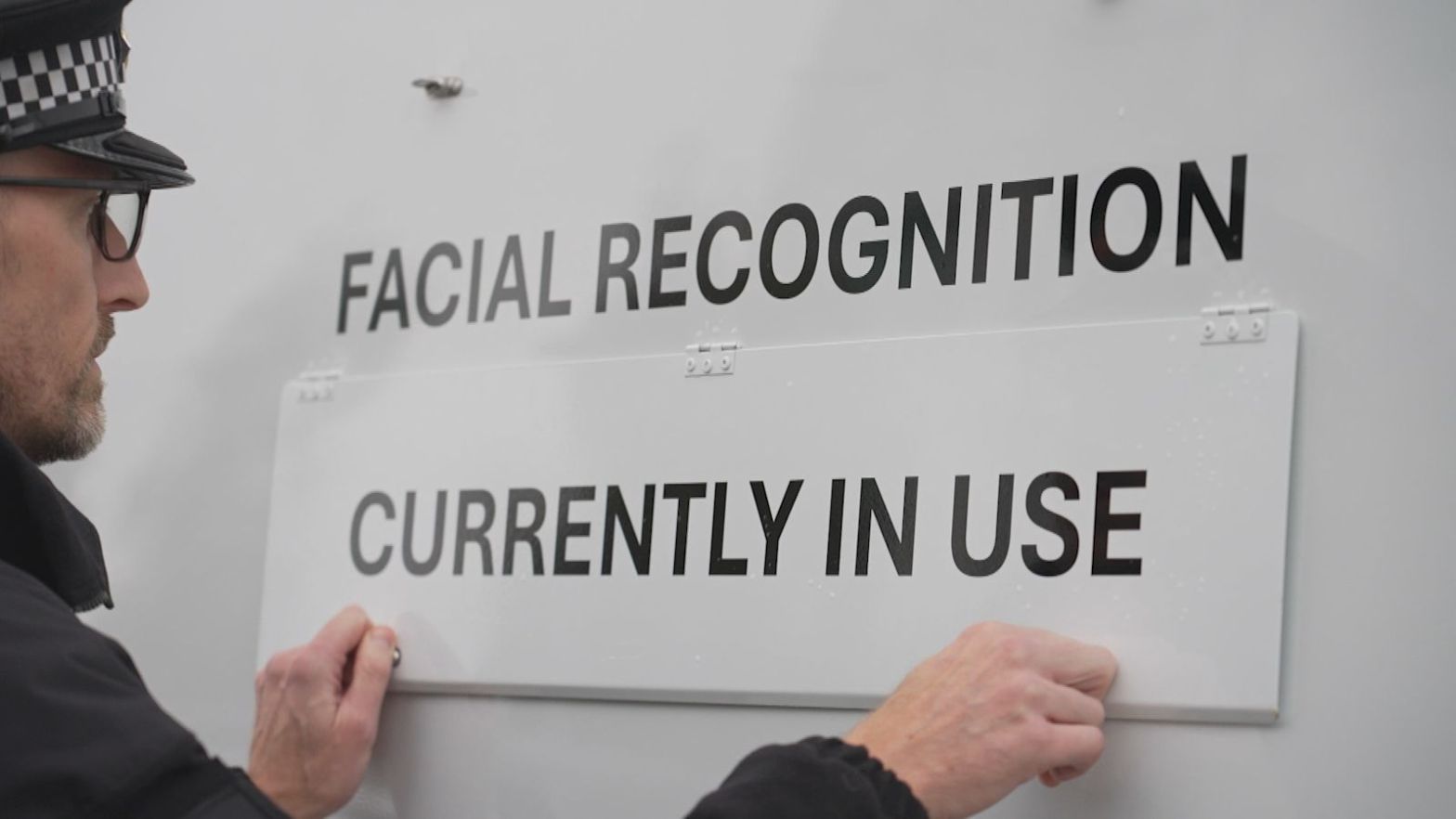
On 4 November 2026, Liberty Investigates uncovered Home Office policy documents showing that live facial recognition, or LFR, is being readied for general immigration enforcement across the UK. The Guardian carried the story that afternoon.
Then we went looking for everyone else.
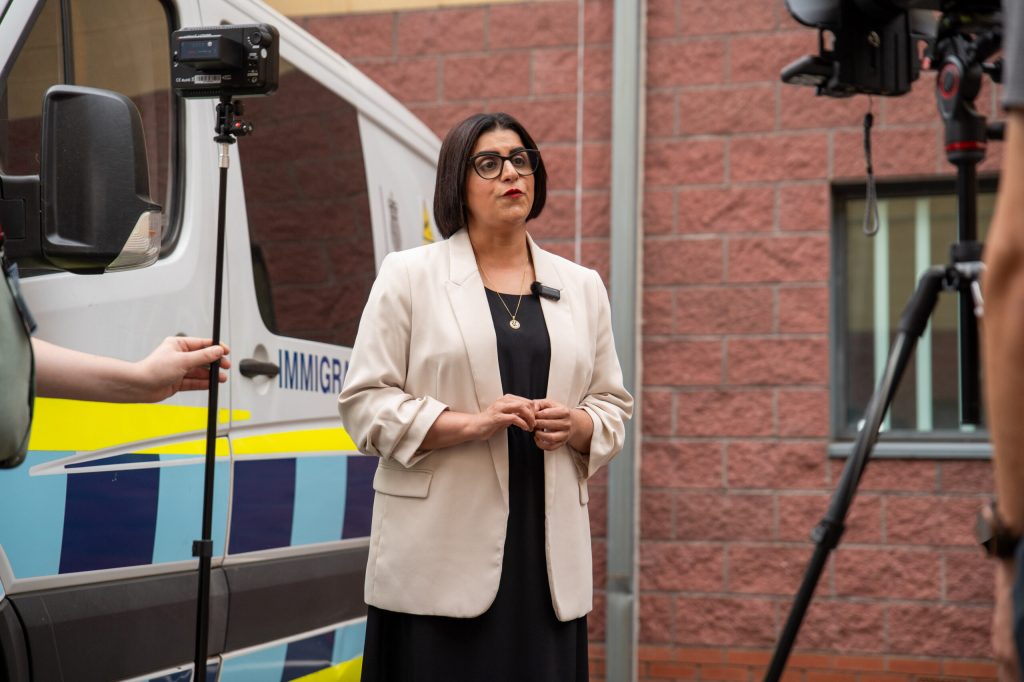
We found it in Punch, in tori.ng, in WithinNigeria, in Legit.ng and in Yen.com.gh. We found it in Eastern Eye. We found it in the trade press that covers biometrics for a living, in Biometric Update and The Register. On 6 November, WithinNigeria published an explainer titled “What Foreigners in Britain Need to Know”.
What we did not find, searching for it, was coverage on the BBC, Sky, ITV, the Times, the Telegraph, the Mail or the Independent.
Yes, not finding something is not always proof that it does not exist, and we would be glad to be corrected. But the shape of that coverage map is worth sitting with. The communities whose faces are about to be scanned are reading about it in newspapers published in Lagos and Accra. A Nigerian outlet wrote the explainer for people living in Britain that British broadcasters did not.
If you only find out what is being built for you by reading in a different continent’s press, that is not a gap in the news cycle. That is a statement about who it is understood that this technology will impact.
WHAT THE DOCUMENTS ACTUALLY SAY
These documents were not leaked. They are published on gov.uk, and you can read them yourself.
The Immigration Enforcement facial recognition policy, version 2.3, was updated on 8 October 2026. An Equality Impact Assessment and a 62 page Data Protection Impact Assessment followed later that month. The DPIA states plainly that the programme has moved out of proof of concept and into formal delivery phase.
The legal basis claimed is Schedule 2 and Schedule 3 of the Immigration Act 1971.
The grounds for ending up on a watchlist are widening. Earlier deployments were narrow, aimed at people returning in breach of deportation orders or wanted for immigration related criminal offences. The new documents point at something broader. They suggest watchlists could include people who have overstayed a visa or entered without leave. Both of those are civil matters. Neither is a crime.
The places are widening too. The documents describe proactive deployments at transport hubs and at specific events expected to increase footfall. One category of higher risk deployment is described as having heightened community sensitivity. When the Home Office was asked what that phrase means, it refused to comment.
This is not confined to ports either. In December 2025, Lord Hanson told Parliament that Immigration Enforcement had already carried out two LFR deployments working with South Wales Police and Greater Manchester Police.
The policy says no one under 18 will be placed on a watchlist. Hold that next to this: earlier this year it emerged that the Home Office had continued using an AI facial age estimation tool after knowing it had misidentified migrant children as adults.
TWO THINGS IN THOSE DOCUMENTS YOU CAN ACTUALLY USE
First, deployments are supposed to be overt. The documents commit to signage, leaflets and uniformed officers present. A covert scan would be outside their own stated policy.
Second, the Home Office says it will publish the purpose, location and timing of deployments in advance where possible, with a figure of at least five days given.
That means this is checkable. If cameras appear in your area with no notice and no signage, that is a question somebody should be able to answer, and it is a question you are entitled to ask.
THE BIAS IS NOT OUR OPINION. IT IS IN THEIR OWN NUMBERS.
The Metropolitan Police publish an annual review of their LFR use. For the year to September 2025, across 203 deployments, they scanned 3,147,436 faces and recorded 10 false positives.
Eight of those ten people were Black. Seven Black men, one Black woman, two white men.
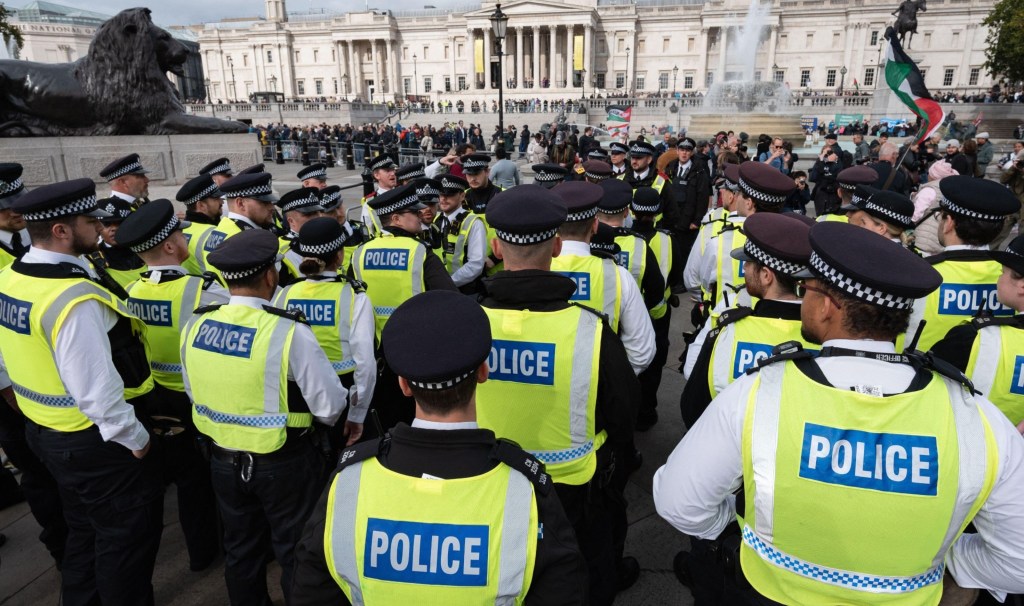
The Met frames this as an error rate of 0.0003 percent, and suggests the pattern reflects where they chose to put the cameras. We would point out that where you choose to put the cameras is itself the decision under scrutiny.
On the national police database tool, testing by the National Physical Laboratory found a false positive rate of 0.04 percent for white subjects, 4.0 percent for Asian subjects and 5.5 percent for Black subjects. For Black women it reached 9.9 percent, against 0.4 percent for Black men.
Police chiefs were told about this in September 2024. The Association of Police and Crime Commissioners described it as a concerning inbuilt bias. The Information Commissioner’s Office demanded urgent clarity from government.
In March 2026, Essex Police suspended their live facial recognition after a Cambridge University study found a potential bias in positive identification rates. In fairness, a second study Essex commissioned found no statistically significant bias, and the Cambridge researchers themselves called their finding suggestive rather than conclusive. We are telling you both, because an argument that only survives on half the evidence is not an argument worth making.
THE COURT SAID IT IS LAWFUL. THAT IS WHY THIS CARD MATTERS MORE, NOT LESS.
On 21 April 2026, the High Court dismissed a challenge to the Metropolitan Police’s live facial recognition policy in Thompson and Carlo v Commissioner of Police of the Metropolis. The court found the policy lawful and compatible with Articles 8, 10 and 11 of the European Convention on Human Rights.
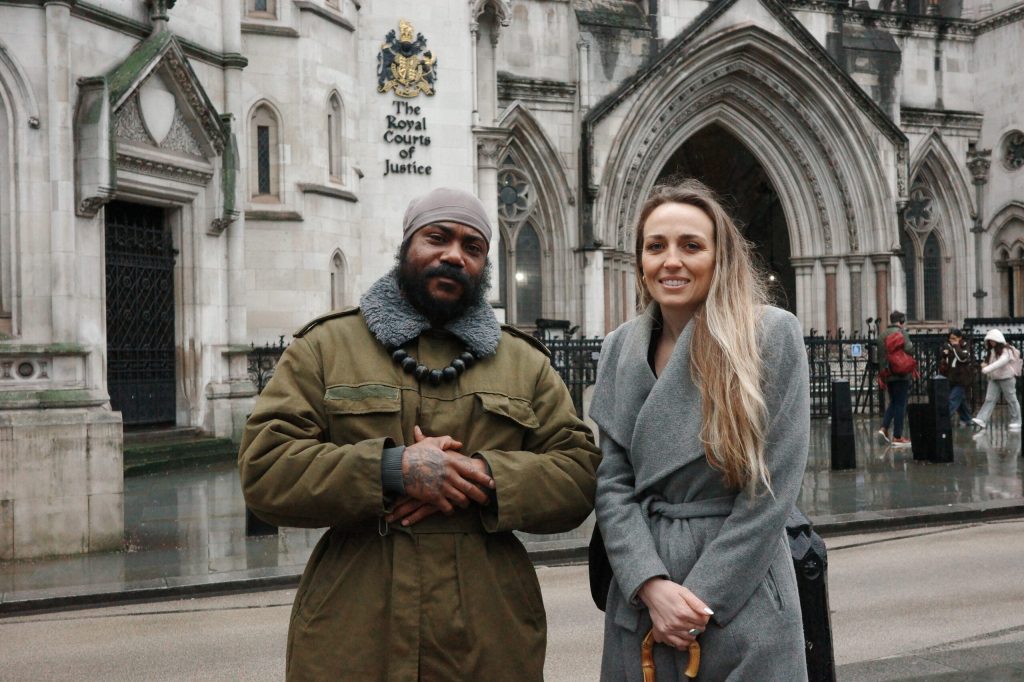
Shaun Thompson, one of the claimants, is a Black anti knife crime youth worker who was misidentified by the technology and stopped by officers. Big Brother Watch, who brought the case with him, are appealing.
After the ruling, the Metropolitan Police Commissioner said the question was no longer whether they should use live facial recognition, but why they would choose not to. The Met is installing permanent static cameras across the West End and Soho by the end of this year. Croydon already has them.
There is still no single piece of UK legislation governing live facial recognition. It has never been passed as its own law by Parliament.
So here is where that leaves us, honestly. The courts have said the policy is lawful. There is no statute to appeal to. The technology is expanding into immigration enforcement while most of the national press looks the other way.
Which means that what you know, in the moment you are stopped, is a very large share of the protection you currently have.
That is what the BUST Card is for.
THE BUST CARD
BLAM UK’s AI Accountability Project has spent 12/18 months researching surveillance, AI and policing in Britain, funded by the European AI and Society Fund. The BUST Card is one of the things we built with it.
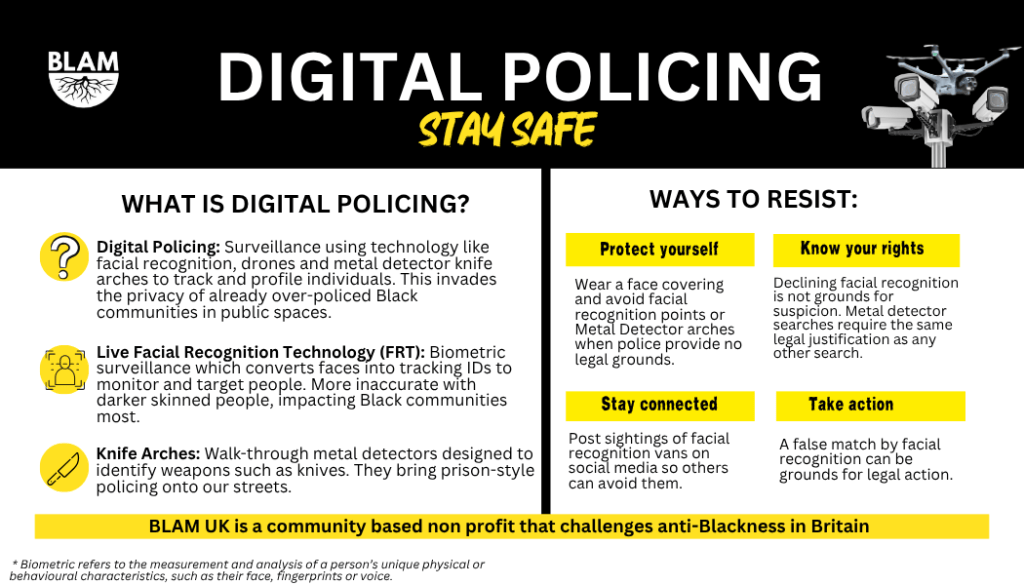
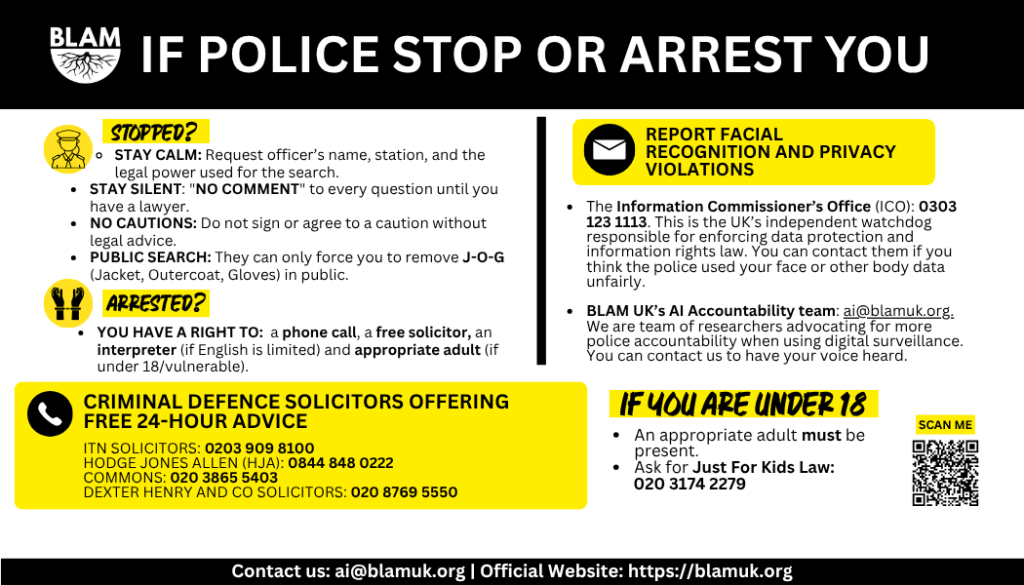
It is short, it is plain English, and it tells you what your rights are if you are stopped, scanned, searched or questioned by police or immigration officers.
It covers:
- Your right to remain silent, and what that means in practice
- Your right to ask the legal basis for a stop or a scan
- What identification you are and are not required to provide
- How to record an interaction safely
- Free 24 hour criminal defence solicitors, with their numbers
- What changes if you are under 18
- How to report a facial recognition or privacy violation, and who to
GET IT
The BUST Card is free. Save it to your phone. Print the wallet sized version for your bag. Send it to anyone you love who moves through this country Black, brown, migrant, or visibly outside the comfort of the state.
Then share this. The best protection a community has is a community that knows its rights. Send it to three people today.
ABOUT BLAM UK
At BLAM UK we are an abolitionist, Black led community organisation. Our AI Accountability Project investigates how AI, surveillance and algorithmic technology are being used against Black communities in Britain, and builds the tools, policy work and public education to push back. We will be launching our report in February 2027.
SOURCES
- Immigration Enforcement facial recognition policy, accessible version, the one that is actually readable: https://www.gov.uk/government/publications/immigration-enforcement-facial-recognition-policy/immigration-enforcement-facial-recognition-policy-accessible
- Equality impact assessment, accessible version: https://www.gov.uk/government/publications/live-facial-recognition-equality-impact-assessment-eia/equality-impact-assessment-accessible-version
- Data protection impact assessment, reported by LexisNexis, 23 October 2026: https://www.lexisnexis.co.uk/legal/news/home-office-publishes-data-protection-impact-assessment-on-live-facial-recognition-technology-in
- Data protection impact assessment, detail on the move to formal delivery phase and the five day advance notice commitment: https://idtechwire.com/home-office-publishes-privacy-assessment-for-immigration-enforcement-live-facial-recognition/
- Biometric Update, UK plan to use LFR for immigration control tests limit of proportionality, November 2026: https://www.biometricupdate.com/202611/uk-plan-to-use-lfr-for-immigration-control-tests-limit-of-proportionality
- Lord Hanson of Flint, written answer HL12835, 23 December 2025, confirming two Immigration Enforcement LFR deployments with South Wales Police and Greater Manchester Police: https://westminsterbrief.co.uk/archive/pq/HL12835
- Metropolitan Police annual LFR review figures, 3,147,436 faces scanned and eight of ten false positives being Black people, reported by The Register, 3 November 2025: https://www.theregister.com/2025/11/03/metropolitan_police_hails_facial_recognition/
- National Physical Laboratory false positive rates by ethnicity, and police chiefs being informed in September 2024, Liberty Investigates: https://libertyinvestigates.org.uk/articles/police-forces-biased-facial-recognition-technology/
- Association of Police and Crime Commissioners statement on inbuilt bias: https://www.apccs.police.uk/apcc-statement-on-facial-recognition-evaluation-report/
- Information Commissioner’s Office calling for urgent clarity on racial bias: https://londondaily.com/uk-data-regulator-demands-urgent-clarity-on-racial-bias-in-police-facial-recognition-systems
- Essex Police suspending live facial recognition after the Cambridge study, including the researchers calling the finding suggestive rather than conclusive, The Register, 20 March 2026: https://www.theregister.com/2026/03/20/uk_police_force_suspend_live_faical_recog_racial_bias/
- Legal analysis of the Thompson and Carlo judgment, CMS: https://cms.law/en/gbr/legal-updates/high-court-upholds-metropolitan-police-s-live-facial-recognition-policy-thompson-anor-r-on-the-application-of-v-commissioner-of-police-of-the
- Metropolitan Police rolling out permanent static cameras across the West End and Soho, and the Commissioner’s response to the ruling: https://localgovernmentlawyer.co.uk/information-law/398-information-law-news/100915-met-police-to-roll-out-permanent-static-facial-recognition-cameras-across-londons-west-end2
- Examples of the diaspora and overseas coverage referenced above:
- WithinNigeria, UK Home Office Facial Recognition Immigration Crackdown: What Foreigners in Britain Need to Know, 6 November 2026: https://www.withinnigeria.com/2026/11/06/uk-home-office-facial-recognition-immigration-crackdown-what-foreigners-in-britain-need-to-know/
- tori.ng, Nigeria, 5 November 2026: https://tori.ng/news/327193/uk-plans-to-use-more-facial-recognition-cameras-to.html
- Eastern Eye: https://www.easterneye.biz/uk-immigration-crackdown-how-facial-recognition-could-change-the-way-migrants-are-tracked/
- Tech Times UK: https://www.techtimes.co.uk/uk-facial-recognition-visa-overstayers-transport-hubs-1809714

