Lessons on Windrush: The Lesser-Known Stories Behind the Windrush Scandal

By Christina Vassell

On March 2019, Windrush Lessons Learned Review was published. It came almost a year after the highly controversial, almost heinous and yet government sanctioned offences against any group of persons within its borders in recent times. 

In short, the Windrush Scandal was and still is, a British political scandal concerning those of Afro-Caribbean descent who were either wrongly detained, denied legal rights, threatened with deportation, or wrongly deported from the UK by the Home Office – the latter occurred in at least 83 cases. 

Yet, while the Windrush Scandal occurred in 2018, the cases included in Williams’ report seemingly evidence that such discriminatory legislations and practices occurred long before the scandal entered the public sphere and garnered mass media coverage. 

Contrary to popular belief, it is a scandal that is longstanding in British history and its genesis can be found in Britian’s imperial and colonial past as well as the many policies that were sanctioned in the mid-60s following the influx of British subjects from across the Commonwealth. 

The first of the arrivals was a passenger ship, The Empire Windrush, carrying 802 people from the Caribbean – including 492 Jamaican immigrants – arrived in Tilbury. The first wave of post-war Caribbean immigrants to arrive in the U.K. were predominantly male, from 1948 to 1950 were mainly men but women soon followed. Between 1948 and 1973, approximately 50,000 people from Jamaica, Barbados, Trinidad and other Caribbean countries, that were part of the British commonwealth, were invited to emigrate to the UK in the aftermaths of WWII. That is, however, not to say that they were treated like British citizens.

Throughout the 50s and 60s it was evident that there was a colour problem in Britain. In 1955, it was said during a BBC television programme that: “Not for the first time in our history we have a colonial problem on our hands. But it’s a colonial problem with a difference. Instead of being thousands of miles away and worrying other people, it’s right here, on the spot, worrying us.” 

For Williams, “The causes of the Windrush scandal can be traced back through successive rounds of policy and legislation about immigration and nationality from the 1960s onwards, the aim of which was to restrict the eligibility of certain groups to live in the UK.” Such legislations that Williams is alluding to is the Commonwealth Act of 1962 controlled and arguably restricted the immigration of all Commonwealth passport holders (except those who held UK passports). 

The Race Relations Act 1965 also did little to stamp out the existing racism towards Black persons from across the Commonwealth, as in 1968, Conservative MP Enoch Powell made an inflammatory, racist and anti-immigration speech. In a few years, legislations would only make it difficult for those coming into the U.K. under the guise of reform. While the Immigration Act confirmed that the Windrush generation had, and have, the right of abode in the UK, Wendy Williams writes that during this period “many were not given any documents to demonstrate this status. Nor were records kept.”

Such a historical legacy would culminate in the “hostile environment” from the late 2000s under Theresa May. It was during this time that Pauline, one of the people included in William’s review experienced immigration problems. 

Born in Jamaica, Pauline (70), was brought up by her grandmother and aunt after her mother left for the UK and started a family in Manchester with a new partner while she was a baby. Pauline was only twelve when she arrived in the U.K. after her mother and step-father invited her to join them in Manchester in 1961. 

After a tumultuous childhood, taking up caring responsibilities only to be abandoned again after her mother would relocated to Canada, Pauline went on to have children and qualified as a social worker. 

Pauline’s Windrush (scandal) story begins in 2005, when she went to Jamaica with her daughter on “a two-week holiday that turned into an eighteen-month nightmare” after being refused re-entry into the UK and subsequently being detained in Jamaica. For Pauline, who had often travelled on her Jamaican Passport, her case demonstrates the wider consensus that many descendants of the Windrush generation felt – that they regarded themselves as British already, thereby not thinking to get British citizenship. 

However, Pauline’s case soon began to take a toll on her mental and physical wellbeing. While she was detained in Jamaica, Pauline could not afford adequate medication for her existing diabetes and almost died after falling into a diabetic coma. During this time, she also lost her job and her house that she planned to buy but was ultimately unable to pay for. 

But the biggest effect was on her children, some of whom were in their teens and didn’t have any resources to help. Her youngest daughter ended up living in a hostel until Pauline’s return. Eventually, a solicitor who specialised in immigration issues was able to help Pauline to return to the UK in 2007. Pauline’s story is one that is the direct result of the “hostile environment” created by Thereas May, then Home Secretary, which began in the early 2000s. 

In 2007, amendments to the UK Borders Act meant automatic deportation for Foreign Nationals who receive a 12-month custodial sentence. Or notably in 2012 when Theresa May’s government issued new a policy that instructed the NHS, landlords, banks, employers and many others with enforcing immigration controls. It would go on to deny many including those from the Windrush generation who had not obtained documentations, proof of status or granted with British citizenship despite their long-term residency, thereby seeing the Windrush Generation and their descendants continually denied, outcasted and exiled by a country that had promised them socioeconomic opportunities for over six decades. 

Instead, changes brought about under the Immigration Act in 2014 introduced additional obstacles for those seeking to challenge [their] deportation on the basis of their family ties or [private] life in the UK.  In order to succeed in a deportation appeal on the basis of your parental relationship, “it is necessary to show that deportation would be ‘unduly harsh’ to the child, which has been interpreted by the Home Office to mean ‘excessively cruel’. But the irony of this amendment is that it glosses over the mishandling of the parents themselves. 

Such is the case for Veronica (59), who lives in Nottingham and came to the U.K. with her father Nathaniel in 1956. Upon arrival, Nathaniel decided not to go for British Citizenship because he already had his “black book” (Citizen of UK and Colonies passport); and like Pauline, he felt that he had been invited to the UK and was already a British Citizen. 

Nathaniel’s troubles began shortly after he and Veronica went to go to Jamaica in 2002. It was while there that he was prevented from returning to the U.K. there despite living in for over forty years, building his life with his wife and three daughters. 

Following the ordeal, Veronica came back to the UK alone and made arrangements to return and care for her father who was becoming increasingly unwell. After spending several years in Jamaica for a total of seven years, with her newfound husband, she decided to return to the UK to sort out her mounting debt and gaps in NI contributions. While in the U.K. Veronica left provision for her father to be looked after by a live-in helper once Joseph, her husband, successfully secured his visa.  

Veronica’s father would never return to the UK, ultimately dying from prostate cancer in 2010. He was not able to afford the cost of treatment in Jamaica, and Veronica believes he could have survived longer if he’d been in the UK with access to NHS treatment. These experiences proved to be debilitating and effected both Veronica’s mental health and career progression. But she feels that partaking in the Review allowed her come to terms with the fourteen-year struggle her father faced. But the price of the scandal is still being paid by Gloria.

Born in Saint Kitts, Gloria (59), travelled to the UK when she was 10 and was raised by her elder sister following their mother’s death. During this time social services were involved with the family because of their young ages. Gloria believes her passport was taken by them and not replaced. 

She eventually found work as a caseworker for people with learning difficulties and mental health issues, and became the main breadwinner in her family following an accident that affected her husband’s ability to work. 

Gloria’s immigration problems began in 2011 when she tried to get a CRB check renewal for the company she had worked at for several years. She failed the check as she did not have a passport, which resulted in her losing her job. Unable to prove her status, Gloria took the company to a tribunal but ultimately lost the case.

Following the trial, Gloria contacted her MP who wrote on her behalf and pleaded her cases to UK Visas and Immigration and Department for Work and Pensions, but to no avail. It would take her seven years to prove her status in the U.K.

As publicity related to the scandal increased, the Taskforce was able to resolve her case in one hour, which was bittersweet to Gloria, who, since losing her job and the tribunal case, had subsequently not been able to work.

In the review, Gloria touches on how the scandal has been detrimental to her mental health and finances. Since the ordeal, she has had to pawn rings to pay for items and visited her doctor on a number of occasions with stress-related problems and depression. Today Gloria claims unemployment benefits and stays at home though nearly lost her house a number of times. 

Gloria’s story is testament to the wider bureaucratic and systemic oppression that targeted the Windrush generation and still affects immigrants thereafter. Today, two years since the scandal, the recommendations of Wiliam’s Review are still under consideration. 

Priti Patel, the Home Secretary, has promised a systemic reform of the Home Office, citing in a Commons statement that the government is committed to introduce a new Home Office mission statement based on “fairness, humanity, openness, diversity and inclusion”. Her response was met with criticism. The Shadow Home Secretary, Nick Thomas-Symonds, criticised the Government for only compensated “just 60 people in its first year of operation”. 

Such a revelation highlights the slow progress in compensating those affected by the Windrush scandal, which up until now exacerbated the lack of trust between the Windrush community and the government. Only 221 out of 1,392 claims have been processed according to Home Office statistics, not factoring the 35 claims that had been rejected since the government launching the scheme in April last year.  

In response to the criticism Patel said: “I agree: the payments and the way in which payments have been made have been far too slow. I’m not apologising for that at all. I have outlined in my statement that it is right that we treat each individual with the respect and dignity they deserve. These are complicated cases.” She said more than £1m had now been offered in compensation.

The Government also previously said that they would pay up to £200 million in total in compensation yet the total pay-outs received by the Windrush victims collectively amounts to a total of £1.2 million. Meanwhile, the deportations still continue.

In February 2020, despite public outcry against the Windrush Scandal of 2018, 17 “criminals” were deported to Jamaica on charter flights under the UK Borders Act. It came as a shock given that there was an Appeal Court order not to deport 25 of the 50 people scheduled to be deported and it is also apparent that such deportations only ended in further tragedy as David Lammy writes in The Guardian, “at least 11 of them died on the streets of foreign countries where they were deported.” 

Needless to say, it is clear that neither the Home Office nor the Home Secretary’s priorities are concerned with “righting the wrongs” of Windrush. But we owe it to the Paulines, Nathaniels and Glorias out there, to ensure that the same bureaucracies that solicited their afflictions does not succeed today.

BLAM UK’s Condemnation of the UK’s Equality Minister Stance on Critical Race Theory.

BLAM UK is one of the few organisations in the UK ensuring the United Nations International Decade of African Descent is being celebrated and championed in the UK. The UK in 2014 failed to ratify the decade. One such important activity and aim of the decade is that it Urges States to ensure that textbooks and other educational materials reflect historical facts accurately as they relate to past tragedies and atrocities, in particular slavery, the slave trade, the transatlantic slave trade and colonialism, so as to avoid stereotypes and the distortion or falsification of these historical facts, which may lead to racism, racial discrimination, xenophobia and related intolerance, including the role of respective countries therein. 

On the 20th October 2020, The UK Equalities Minister made a statement to the effect of suggesting that racism is a debatable topic, not only is this a problematic stance, it suggests that racism and white supremacy are matters that do not exist in society. We refute any such claims from a Government that continues to produce and uphold policies that allow racial discrimination to thrive in all aspects of British society, including education. We know Black Caribbean students are 3x more likely to be excluded from school and Black students are routinely underpredicted in schools. Instead of the Minster to be creating and drafting potential policies to end these racist practices, she wants to censor the very notions that will help us in achieving a more fair, balanced and equitable society. 

The Minister’s stance is simply furthering the Government’s desire to effectively censor teachers ( a trend started by the Government’s recently drafted PSHE Guidance that is facing a legal challenge ).  By suggesting that it is illegal to present a fact as an actual fact, she is attempting to create a culture of politically motivated state-sanctioned censorship of anybody who is deemed to be “radical or left”.  It must be of note that a government minister (who is not a teacher and nor is she a judge) should not be allowed to state claims that are not in line with the UK’s international human rights obligations. The Minister’s stance is incompatible with the right to freedom of thought and also the UK’s obligation under the International Convention to End Racial Discrimination ( ICERD). Under ICERD Art.7- State Parties undertake to adopt immediate and effective measures, particularly in the fields of teaching, education, culture and information, with a view to combating prejudices which lead to racial discrimination and to promoting understanding, tolerance and friendship among nations and racial or ethnical groups, as well as to propagating the purposes and principles of the Charter of the United Nations, the Universal Declaration of Human Rights, the United Nations Declaration on the Elimination of All Forms of Racial Discrimination, and this Convention. The UK is obligated under international law to take immediate and effective measures in the field of teaching and one such effective measure is the teaching of Critical Race Theory.

If we look even closer to home at the UK’s Domestic laws on Equality and discrimination, we see the following under Equality Act 2010, s149 para 1 there is a  Public sector equality duty:

(1)A public authority must, in the exercise of its functions, have due regard to the need to—

(a)eliminate discrimination, harassment, victimisation and any other conduct that is prohibited by or under this Act;

(b)advance equality of opportunity between persons who share a relevant protected characteristic and persons who do not share it;

(c)foster good relations between persons who share a relevant protected characteristic and persons who do not share it. 

The Minister’s stance again is not in line with the public sector equality duty that school must legally adhere too. It is important that Ministers, who do not have the function in society as Judges are not left to interpret the law and how it should be applied. We have a separation of powers in the UK and the minister must be reminded of this, as she takes the notion of asserting what is legal; even when this is not in line with UK’s international obligations and domestic law. 

In a year where we have revisited the historically and ongoing legacies of white supremacy, it is imperative that the UK government creates further guidance that supports its international human rights obligations.


We urge schools to resist this politically motivated sanction from the Government.  We ask them to further their pledge to eliminate racial discrimination and to adhere to the Equality Act 2010  Public Sector Duty–  and continue to rightfully teach narratives that assist in the fight to eliminate racial discrimination in all parts of society.

By Ife Thompson

BLAM UK Volunteer Jessica Perera produces a damning report, showing how the exclusions system continues to fail Black Working-Class Students.

Jessica Perera has supported BLAM UK for the past year, as a volunteer school exclusions advocate. She has witnessed first hand how the system unfairly punishes Black students from inner city london who are faced with exclusions. As an advocate, she supported one family who were forced to become part of the PRU( Pupil Referral Unit) system by a way of a managed move. 

The case Perera worked on is not unique, many young Black boys are funneled in the PRU system. The report drafted by Perera  for the Institute of Race Relations further highlights this racialised injustice, alongside the effects of gentrification and privatisation of the education system. The report also brings to light the following key inequities of the government backed business of expanding the PRU sector, by rebranding it as Alternative Provision and privatising it through academisation. We should be concerned as only 4% of students in Alternative Provision’s leave with GCSE’s. The School Exclusions policy we have in place in the U.K is allowing the educational attainment gap to further widen on class and racial lines, they are also playing a key role in what we term in the UK as the Pru- Prison Pipeline. 

The IRR’s new paper, How Black Working-Class Youth are Criminalised and Excluded in the English School System: A London Case Study, reveals that over the past forty years, exclusion from mainstream school has coincided with systematic ‘educational enclosure’.

Read the full report here

Jessica Perera is an Associate Researcher at the Institute of Race Relations and author of The London Clearances: Race, Housing and Policing, published in 2019. She is also an Economic and Social Research Council-funded DPhil candidate at the University of Oxford, under the supervision of Professor Danny Dorling.

Why World Afro Day is Important to us by Destini Bleu

September 15th, 2020 marks the fourth annual World Afro Day. A day which celebrates Afro hair, culture and identity, whilst drawing attention to problems such as hair discrimination and inequality. The key aims of World Afro Day are to spotlight Afro excellence, raise awareness and create normalisation and relating to Afro hair and the education of wider society about Afro Hair.

Westernised beauty standards dictate that straight hair is the essence of not only beauty but also success. This is evident within; fairy tales, films, television, social media, consumer products and advertising etc. Whilst Afro hair for centuries has often been the subject of disdain and ridicule. As a result of their natural hair, Black people have and are currently facing microaggressions and overt racism, they are often told it is ‘dirty’ or ‘unprofessional’ and even excluded from school or even fired from their jobs.

This year World Afro Day’s mission focuses on the eradication of any discrimination around Afro hair within schools. Whilst there have been major changes in the America such as the CROWN Act which prevent and protect Afro hair from discrimination, the World Afro Day organisation believe that there is a way to go in the UK.

 Michelle De Leon, founder of World Afro Day notes that ‘95% of people with Afro hair in the UK, want policies that punish our children to be removed from schools’ and as such World Afro Day 2020 is the start of a 30-day call to schools and headteachers to comply with the Equality Act and eradicate any discrimination around Afro hair. Michelle adds that ‘‘This is not fashion, it’s more fundamental than that – school hair policies harass and harm our children. This about equality and justice and the time for action is now.’ 

World Afro Day 2020 will celebrate the beauty of Afro hair through a series of online events and celebrations. In addition, councils such as Hackney have introduced a range of books celebrating Afro Hair to libraries across the borough to celebrate World Afro Day for the first time. Importantly, today marks an important step in the journey towards ensuring the protection of Afro Hair through law in the UK.

Path to Revolution: The History of Rebellion in Jamaica by Malaika Laing-Grant

Some would contend that the abolition of slavery and the liberation of the wider British Empire, was brought to a natural conclusion due to parliamentary processes and reform, or to the alleged decline in significance for the British economy. For many scholars, this contention is largely a misconception which disregards the fundamental revolutionary processes at play. Indeed, when considering the history of the British West Indies in the context of its revolutionary struggles, there is more than meets the eye!

Reflecting on Jamaica’s past, the emancipation of slaves, and the subsequent fight for independence was won on the ground following a succession of strategic revolutionary processes, rather than a  single uprising. The Morant Bay Rebellion (1865), in particular, was a key moment among others in post-slavery Jamaican history which not only exposes the ingenuity and tenacity of black Jamaicans, but the ironic reality of oppression and suffering that ensued following the abolition of slavery in the British West Indies in 1838. 

Despite being freed from slavery, living conditions, political representation and economic prospects for the black population continued to leave them at a clear disadvantage. Black Jamaicans found themselves in severe poverty, which was compounded by the severe economic downturn in Jamaica following the decline of the sugar industry post abolition. Furthermore, those who wanted to branch out on their own were starkly disenfranchised by the Jamaican colonial laws that punished Jamaican’s for the most minuscule of infractions and instituted unaffordable taxes, all designed to frustrate the former slaves and force them to return to the sugar plantations. 

Several months ahead of the notorious rebellion, Jamaican workers from Saint Ann parish had respectfully articulated their grievances to Queen Victoria in April 1865. Much to their dismay, Governor Eyre, who intercepted the petition, persuaded the monarch to deny their request. Angered by the continued subjugation of the poor, and triggered by the trial of a black man who was arrested for trespassing on an abandoned plantation, Paul Bogle, with the support of George William Gordon, decided to take action. In early October 1865, Bogle led a group of men and women to the courthouse in Morant Bay, where they met with soldiers who opened fire. In the aftermath that followed, both Paul Bogle and George William Gordon, as well as many hundreds of others, were caught and executed in the subsequent fighting and reprisals.

The use of martial law to permit these deaths quickly led to one of the most severe acts of brutal force against unrest in the history of the British West Indies. Governor Eyre had not only ordered extensive and harsh reprisals against the Black Jamaicans in the county of Surrey, but he had also directed brutal force against communities and individuals, much of whom were innocent men and women. Ultimately, the violent suppression and brutality generated widespread controversy in England and, as a result, Governor Eyre was ousted for his unconstitutional actions in response to the rebellion.

Outcomes aside, the revolutionary uprisings which took place in Jamaica were an unequivocal part of a revolutionary process, arguably putting Jamaica on the road to independence, which finally came in 1962. They were, in effect, undermining the very fabric that comprised Jamaican society to legitimise the freedom of former slaves and their descendants – not just under the view of the colonial state, but via their own conceptualisations. 

What is clear from this brief history of Jamaica’s revolutionary processes is that the Morant Bay Uprisings was not merely one of the myriad of slave revolts in Jamaica. It is symbolic of the culmination of strategic socio-political ruptures in the Anglophone Caribbean more generally, and Jamaica specifically. While these ruptures did not automatically translate into a socio-political transformation identical to the classical theories of revolution we know of today, it was through such struggles that the people of Jamaica were able to catalyse emancipatory legislation and legitimise their freedoms. 

Written by Malaika Laing-Grant

Path to Revolution: The History of Rebellion in Jamaica

Some would contend that the abolition of slavery and the liberation of the wider British Empire, was brought to a natural conclusion due to parliamentary processes and reform, or to the alleged decline in significance for the British economy. For many scholars, this contention is largely a misconception which disregards the fundamental revolutionary processes at play. Indeed, when considering the history of the British West Indies in the context of its revolutionary struggles, there is more than meets the eye!

Reflecting on Jamaica’s past, the emancipation of slaves, and the subsequent fight for independence was won on the ground following a succession of strategic revolutionary processes, rather than a  single uprising. The Morant Bay Rebellion (1865), in particular, was a key moment among others in post-slavery Jamaican history which not only exposes the ingenuity and tenacity of black Jamaicans, but the ironic reality of oppression and suffering that ensued following the abolition of slavery in the British West Indies in 1838. 

Despite being freed from slavery, living conditions, political representation and economic prospects for the black population continued to leave them at a clear disadvantage. Black Jamaicans found themselves in severe poverty, which was compounded by the severe economic downturn in Jamaica following the decline of the sugar industry post abolition. Furthermore, those who wanted to branch out on their own were starkly disenfranchised by the Jamaican colonial laws that punished Jamaican’s for the most minuscule of infractions and instituted unaffordable taxes, all designed to frustrate the former slaves and force them to return to the sugar plantations. 

Several months ahead of the notorious rebellion, Jamaican workers from Saint Ann parish had respectfully articulated their grievances to Queen Victoria in April 1865. Much to their dismay, Governor Eyre, who intercepted the petition, persuaded the monarch to deny their request. Angered by the continued subjugation of the poor, and triggered by the trial of a black man who was arrested for trespassing on an abandoned plantation, Paul Bogle, with the support of George William Gordon, decided to take action. In early October 1865, Bogle led a group of men and women to the courthouse in Morant Bay, where they met with soldiers who opened fire. In the aftermath that followed, both Paul Bogle and George William Gordon, as well as many hundreds of others, were caught and executed in the subsequent fighting and reprisals.

The use of martial law to permit these deaths quickly led to one of the most severe acts of brutal force against unrest in the history of the British West Indies. Governor Eyre had not only ordered extensive and harsh reprisals against the Black Jamaicans in the county of Surrey, but he had also directed brutal force against communities and individuals, much of whom were innocent men and women. Ultimately, the violent suppression and brutality generated widespread controversy in England and, as a result, Governor Eyre was ousted for his unconstitutional actions in response to the rebellion.

Outcomes aside, the revolutionary uprisings which took place in Jamaica were an unequivocal part of a revolutionary process, arguably putting Jamaica on the road to independence, which finally came in 1962. They were, in effect, undermining the very fabric that comprised Jamaican society to legitimise the freedom of former slaves and their descendants – not just under the view of the colonial state, but via their own conceptualisations. 

What is clear from this brief history of Jamaica’s revolutionary processes is that the Morant Bay Uprisings was not merely one of the myriad of slave revolts in Jamaica. It is symbolic of the culmination of strategic socio-political ruptures in the Anglophone Caribbean more generally, and Jamaica specifically. While these ruptures did not automatically translate into a socio-political transformation identical to the classical theories of revolution we know of today, it was through such struggles that the people of Jamaica were able to catalyse emancipatory legislation and legitimise their freedoms. 

Written by Malaika Laing-Grant

BLAM’s Volunteer Blog editor

Malaika is a professional with over five years’ practical experience in the international development space, providing comprehensive programmatic support to drive programme success in areas such as youth and politics, social and economic development, education and capacity building. She is a strong believer in the power of the Black community, Malaika is also committed to education as a form of Black empowerment to dismantle cycles of oppression and systems of social injustice. 

Mental Health & Therapy in the Black Community by Tavie-Tiffany Agama

In this short piece Tavie explores the issues that many Black people face in the UK when seeking professional help for their mental health and questions whether the mental health services in this country are doing enough to cater to our needs.

“Other people are going through much worse you know?”

“Have you been praying/reading your Bible?”

“You just need some fresh air to take your mind off things”

Mental illnesses like depression and anxiety are often met with these kinds of minimising statements due to a widespread lack of understanding but the ignorance surrounding mental health is not surprising when you consider how uncomfortable the topic seems to make people.Admitting to a flare up of chronic back pain or asthma with your work colleagues would not stop the conversation in its tracks… But responding to “how was your weekend?” with “my depression is affecting me so badly that it’s hard to get out of bed most days” would most certainly derail the light-hearted morning pleasantries.

Why is this?

Read Full Article below.

Join us in our Racial Wellness Workshops providing tailored solution-led sessions for Black people’s mental health within the UK.

Fifty Years On: The Mangrove Nine Protest by Ruby Koopman


The 9 th August 2020 marked the fiftieth anniversary of the Mangrove Restaurant protest; this however was more than just a “restaurant”- the Mangrove was an important hub for the Black community, a regular meeting spot for Black intellectuals and activists. The peaceful protest in London’s Notting Hill was as a result of the constant targeting and raiding of the restaurant by police, amounting to twelve instances between January and July of 1970. The Metropolitan Police attempted to justify their disproportionate interest in the restaurant as responding to suspicions of drug possession. No drugs were ever found during any of these raids.
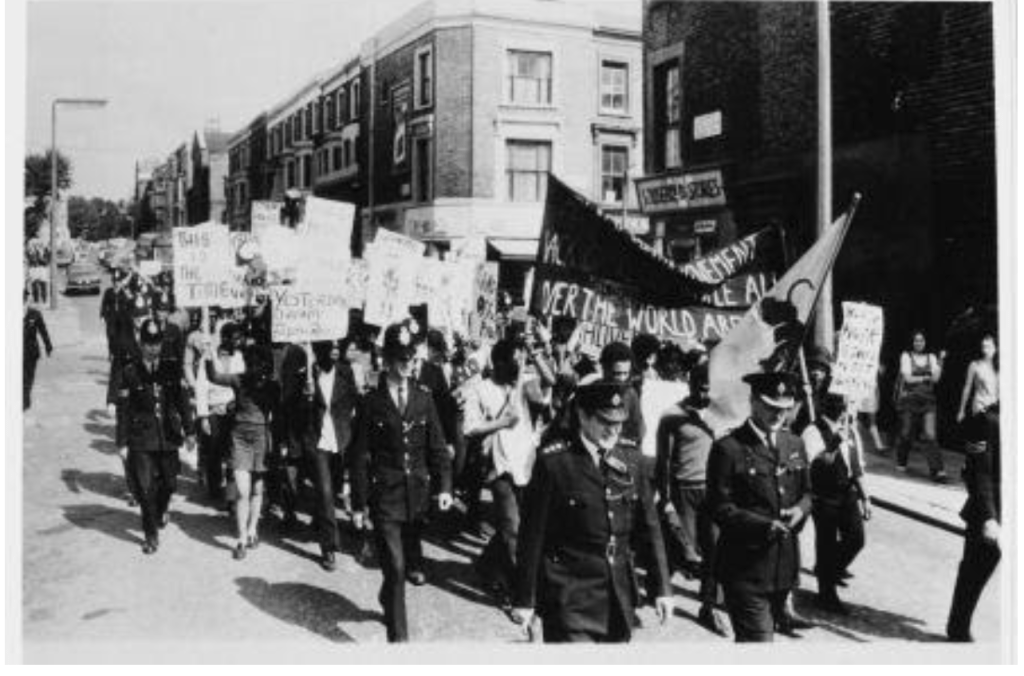
The protest was planned for 9 th August 1970 as a response to the relentless over-policing of the Mangrove. The protest was organised by Activists from The Action Committee for the Defence of the Mangrove, the British Black Panthers, the Black Improvement Organisation, and the indomitable Trinidadian restaurant owner, Crichlow. They all marched to the local police station to confront the ongoing, unjust profiling. The peaceful protest of 150 activists was met by a police force of 200, with 500 additional officers available if they were deemed necessary. The disproportionate police presence is evidence of the fictitious perceived threat of the Black community. Although the march was peaceful, the police responded with violence.

The trial of the Mangrove Nine then took a winding course. Originally, the presiding magistrate dismissed the case as it was clear the twelve police officers giving evidence equated the ideals of Black radicalism (the emerging political theory of racial justice developed in the US) with criminal intent. As with contemporary radicalism, the redistribution of social, economic, and political power that the Black radical movement sought was understood by those who held power to be a dangerous shift and therefore criminal.
Although this original case was thrown out, the Director of Public Prosecutions re-arrested the nine activists on the same charge, determined to use them as a deterrent against the rise of radical politics in marginalised communities. The Nine, however, responded by politicising the trial for their own cause. Two of the Nine opt-ed for self-representation, in keeping with the black radical tradition and an unprecedented tactic that enhanced public interest. Moreover, the Nine demanded an all-black jury, under the Magna Carta’s express instructions for criminal cases to be judged by one’s “peers”. This tactic was disallowed but brought further notoriety to the case by highlighting potential jurors’ misconceptions of the Black power movement. In the end, only two of the twelve jurors were Black.

Nine activists were arrested with charges of inciting a riot: Frank Crichlow (owner of the Mangrove Restaurant), Althea Lecointe Jones, Darcus Howe, Barbara Beese, Rupert Boyce, Rhodan Gordon, Anthony Innis, Rothwell Kentish and Godfrey Millett.


However, much of the final jury was working class, and the Nine re-strategized and used this demographic to their advantage. They highlighted the intersection between racial and class injustice and reminded the jury they too were victims of the powerful British establishment. Further, the Nine pointed to the status imbalance within the court room, showing the prosecution and the establishment to have vested interest in the elimination of radical thought, as such movements might disrupt the status quo they continually benefit from. The Nine also aligned their case with the African American fight against racial oppression and Black nationalists fighting for self-determination in the colonies.

After 55 days of the high-profile trial at the Old Bailey, all nine were acquitted of the main charge of inciting a riot. Further, the judge conceded that the police were motivated by racial prejudice. The decision was an enormous victory for the activists and the community as they had proven marginalised groups could challenge the seemingly immutable power of the police and the criminal justice system, and win. The British Black Panthers and black radicalism gained credibility after the trial, although this resulted in tighter controls and surveillance by the Metropolitan Police. Nonetheless, the significance of the march and the subsequent trial to the development of Black radicalism in Britain cannot be understated.
Fifty years on, as the fight against racial profiling in the police and racial discrimination in courtrooms still rages, it is important to remember the creativity, determination and fearlessness of the Mangrove Nine who relentlessly pursued their rights; and won.

Ruby is a recent History graduate with a particular interest in underrepresented narratives. She is beginning her law conversion course in September 2020 with the aspiration to become a social welfare and civil liberties solicitor.

Why we need a move towards a Transformative Justice framework within schools by Ife Thompson

In the absence of government-led reforms to the current racist, chaotic and unregulated state of the Schools exclusion system we have in the UK, we are calling for a school-led change to supporting young people.  We at BLAM UK are calling on schools to channel their energy into less punitive approaches that will, in turn, allow the demise in the current usage of immoderate approaches that inform the excluding process for children. 

In this short post, it will be argued that a move to more contemporary forms of understanding children’s behaviours is the only approach that should be championed in schools. We believe that transformative justice is a framework that should be used by all schools in the UK.

The Current Issues 

The current school exclusion system is punitive and discriminatory, it sees Black Caribbean pupils 3 X more likely to be excluded than their white counterparts.  Last year in the UK we permanently excluded 7,894 young people. The current system allows for children to become further disillusioned with the education system. It is also damaging the scope of progress for young peoples futures  ‘ 96% of pupils in alternative provision fail GCSEs’.

Thus pushing them firmly into the school to prison pipeline- ‘exclusion is a marker for being at higher risk of becoming a victim or perpetrator of crime– 23% of young offenders sentenced to less than 12 months in custody, in 2014, had been permanently excluded from school prior to their sentence date.’ The current frameworks used in the school exclusion system are not fit for purpose, as they are allowing too many young to go unsupported. 

Reimaging how we support children through a Transformative Justice Framework?

 The Transformative Justice framework was further enhanced through the work of ‘Ruth Morris, a Quaker in Canada, challenged restorative justice because it did not address issues of oppression, injustices, and social inequities within conflicts….Morris argues that while restorative justice challenges the retributive justice system and brings people together, it fails to recognize the socio-political and economic issues addressed by transformative justice’.

Although transformative justice builds on the framework of restorative justice, it goes further by encouraging those using its framework to think wider than the person at hand who has caused the harm, and urges them to centre in the socio-political factors that will have influenced a persons behaviour. 

The research by Anthony J. Nocella II shows different organisations approaches to using Transformative justice- AVP, Save the Kids, and Generation Five to emphasise what may be thought of as the core philosophy of transformative justice (TJ): 

· TJ is against violence and punishment, institutionalization and imprisonment. 

· Crime is a form of community-based conflict, where society and the government are also involved as possible offenders. 

· TJ brings issues of identity back into the realm of justice by addressing socio-political injustices toward Women, People of color,  GLBT, Poor, Immigrants, People with Disabilities, and other marginalised groups. 

· TJ believes in the value of mediation, negotiation, and community circles to transform conflicts. 

 ‘Transformative justice, while addressing oppression and the role that groups, institutions, and agencies have in creating and maintaining oppression, does not view anyone as an enemy, but rather argues that everyone needs to be involved in a voluntary safe constructive critical dialogue where people take accountability, responsibility, and the initiative to heal.’ Transformative justice centres the notion of communal healing from harms. This could look like ensuring that there is a counsellor that can support the young person in your school that maybe be having behaviour problems. It could like referring them to children’s counselling organisations. It also looks like providing a holistic plan that doesn’t seek to punish the behaviour but instead look at why this happened?, what socio-political context is this happening in? How it happened? What can be done to prevent this from happening again?. The UK Government summary on school exclusions showed ‘ Persistent disruptive behaviour is the most common reason for both permanent exclusions (35%)’ it can, therefore, be argued that if the  ‘disruptive behaviour’ is interrupted and treated within a holistic framework supported by Transformative justice, we could see a change that will allow us to provide the much-needed support many of these young people often need. 

Next steps for schools 

We at BLAM UK would encourage schools to follow best practice from schools in Scotland that have drastically reduced the use of school exclusions, last year there was only 3 permanent exclusions.

No police in schools. We would encourage schools to stop the further criminalisation of children that is aiding in the school to prison pipeline. We would encourage educators to support the current no police in schools campaign by Kids of Colour and the Northern Police Monitoring Project.

To read more texts on Transformative Justice and to reword behaviour policies to take into account this new transformative approach to supporting young people.

Written by our Founder Ife Thompson she is a Barrister, community activist and former youth worker. 

Black Geographies: Mapping Political Movements By Malaika Laing-Grant

In my previous article, I briefly touched on the evolution of Black Geographies, as well as some of the prominent thematic areas within the Black Geographies scholarship, including space‐making, and the Black geographic imagination. Here, I investigate the relationship between geographic regions and black political movements as a core and inextricable element of the Black Geographies scholarship. The first approach I take examines the social tactics employed by Black individuals and communities in the face of systemic racism and social injustice. The second, focusses on the ideas of Black thinkers and movements that were active in seeking political alternatives to the racist options offered by mainstream politics. Lastly, I reflect upon the transcendent nature of the emancipatory efforts exercised in the global fight against imperialism. 

Social Movements as an Act of Resistance?

Some scholars of Black Geographies would argue that black social movements emerged as a response to systemic racism, social injustice and efforts to maintain and reproduce the power of the elite. In the face of these daunting realities, critiques of regional power and culture based on the black imaginary manifested in the form of music, Black literature, the arts, and more. Essentially, this emerging discourse moves away from trivial debates on race by a society’s elite. Rather, scholars including Claudia Jones, Stuart Hall, Katherine McKittrick, Bell Hooks, among others, have challenged the mainstream narratives that continue to perpetuate problematic stereotypes and paved the way for a system of explanation that informs daily life, organisational activity, culture, religion, and social movements.

Political Movements in the face of Imperialism?

The second approach, which frames activism against the development of black communities, illustrates how the geographies of white imperialism informs political movements and how these groups perceive themselves. Falling in line with this theory are movements such as the Black Liberation Front, the Mangrove Nine and the British Black Panthers, which had a significant impact on the Black British political landscape and played a key role in the black community in London and elsewhere. The Black Liberation Front in particular, was born out of the historical liberation struggles in Africa and throughout the African diaspora. By establishing supplementary schools, community bookshops, affordable housing for black families and support for black prisoners, the movement focused on developing Pan-African consciousness, consolidating black political identity and challenging the impact of racism in Britain. In essence, the movement reflected the main geographical challenges faced by black communities in the UK at the time; such as the lack of racial integration of black and white families with similar class affiliations, disproportionate incarceration of Black people and the challenges concerning identity. 

Transcending Boundaries

Not only did organisations such as the Black Liberation Front respond to the geographical challenges faced by their communities at home, they also advocated as part of a collective struggle for the liberation of the African continent and throughout the Black/African diaspora. At the heart of this argument lies African/Black Internationalism, the emerging body of intellectual practice and political culture forged in response to slavery, racial oppression and colonialism. Since the emergence of black internationalism during the revolutions of the 1960s and 70s, black political movements in the UK, among the many other influential actors at the time, have been at its forefront.  Their writings and activism espoused a Pan-African, global consciousness and an overarching notion of black liberation. According to Black Geographers, these Pan-African anti-racist works, which connected the African continent with the African Diaspora and black radical movements active at the time, are geographic in nature and provided concrete organisational and institutional structures to facilitate Pan Africanism, liberation and freedom from imperialism in all of its forms and manifestations across the globe.

Importantly, the relevance of Black Geographies is not only limited to the diaspora. In 1896, following years of tense relations with the British, Yaa Asantewaa, Queen Mother of the Asante confederacy, stood firm and mobilised troops to fight against the threat of British imperialism in the Asante nation, located in what is modern-day Ghana. Whilst the Asante ultimately lost to the hands of British imperialists, Yaa Asantewaa remains a powerful reminder of the African resistance against colonialism and the inspirational fight to maintain and reproduce African space due to her impactful actions in empowering her people against the British army. 

Looking Forward.

While Black Geographies has done well in providing an alternative discourse to the Black spatial experience, scholars have been careful not to credit the production of Black geography alone as the sole influence over the formation of black political movements. More recently, we now begin to see the start of a political awakening which has seen the explicit rise of opposing political and academic ideologies within Black/African communities across the globe,  effectively challenging the notion of communalism as a core element of Black spatial agency. This transformation has reared its head as an emerging separation from the perceived black imaginary, often associated with communalism, to the individuality and exclusivity of the modern era.

As academia evolves, it is interesting to see how scholars have established and developed political theory out of the struggles in Africa and throughout the African diaspora to provide us with an opportunity to tear down backwards notions that limit the involvement of our people. However, it is always important to contextualise, given the historical revolutions that have taken place in our diverse societies over the course of the last 500 years. For authors such as the likes of Olúfẹ́mi Táíwò, “the types of communalism that are on offer do not appear to take this fact of radical change with the necessary urgency” (O.Táíwò, 2016). It is, therefore, alongside other work in the field of African Studies that I believe that Black Geographies is and can be put to work alongside other disciplines and approaches that have so far been absent in the mainstream narrative.

(Written by Malaika Laing-Grant)