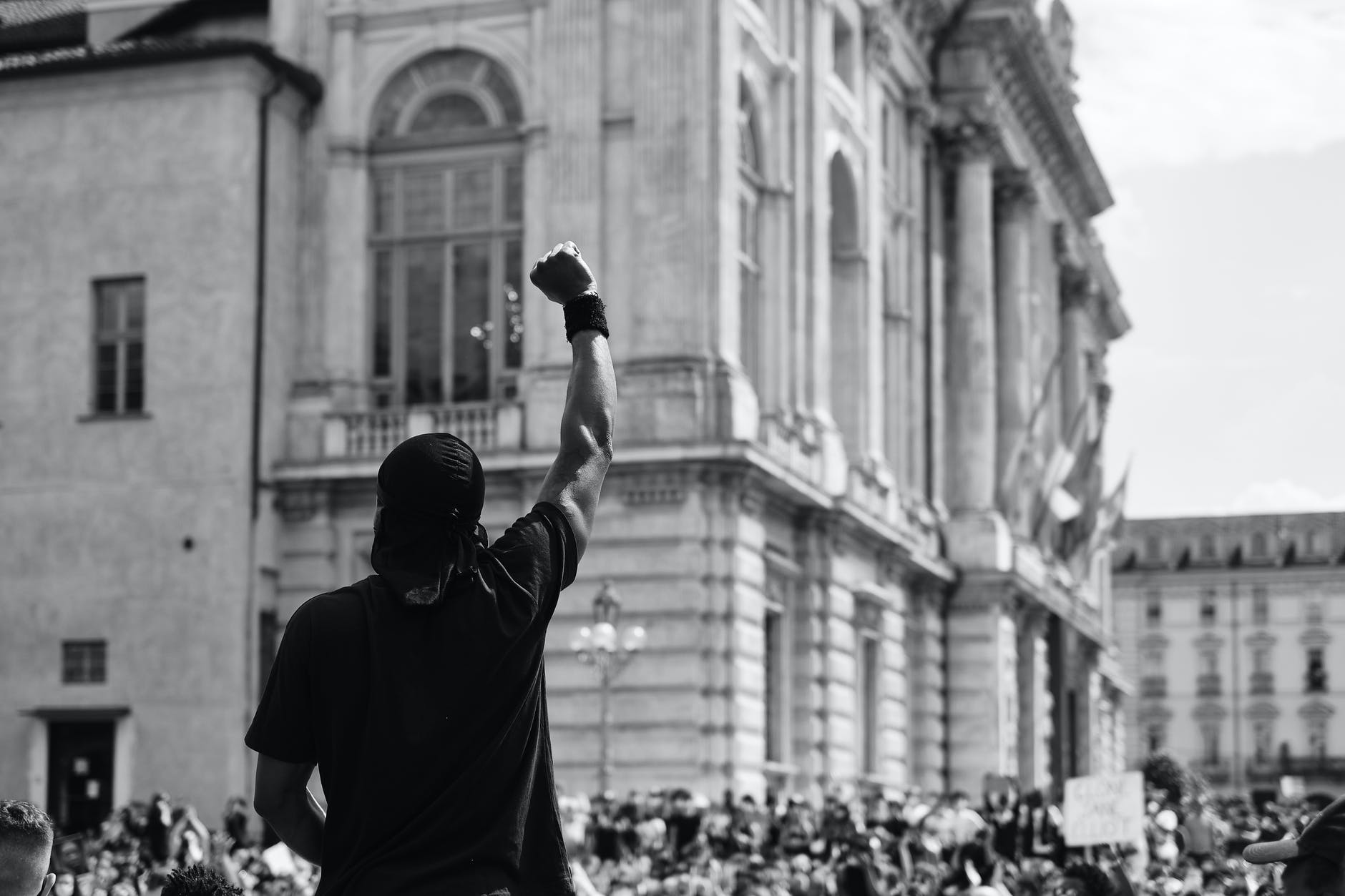
Why The Black Lives Matter Movement Matters to Me ( BLAM UK Essay Competition) By Tapiwa Chingati-Phiri Aged-16

I am the future. A way maker and a change maker. So, I owe it to my ancestors, my younger self and my legacy that I kneel with the movement, that I stand with the movement and that I march with the movement to fight for our rights.


To me, the Black Lives Matter Movement is not black vs white or just some angry group of black people shouting with a “political” agenda. It is all of us in our many beautiful colours against the injustice that is racism for the greater good of all people and I can’t think of anything better than having love and acceptance as the focal point of society. Furthermore, I will forever stand with my brothers and sisters of the movement because how can I comfortably go to sleep whilst another is unlawfully murdered on the streets.
But it starts smaller than because even as a child I felt different. Like a second-class citizen. I was treated like I didn’t belong. Even though the UK was the only place I called home. So, I don’t want any child to feel the pain I did. To go through all the bullying and the life I lived. Therefore, I want true freedom of speech as I no longer want to run or hide because so many times, I have had to cover up my true feelings, I felt I had to stay silent about what going on inside. But now I want equity and equality because that is what we as a country should strive for as it is our human right. So, I can just be me and be able to love my skin and be proud of it and feel that it is a treasure, not a hindrance.
So, like those that came before me, I must speak out, petition, march and help educate because I have seen the truth and I have grown because of it. But I will not be forced to just survive, till we take control, because racism has no place in society as it wrecks lives and distorts harmony.

Black Spatial Agency Matters: The Rise of Black Geographies By Malaika Laing-Grant

There is an unequivocal push to shed light on the deepening racial divides that continue to underpin the Black experience in the 21st Century. Black liberation movements around the world, from the bustling streets of London to the southeastern coasts of Jamaica, have brought the importance of blackness to the fore. Not only as a tool for understanding the Black identity, but also as a theoretical framework from which to view our emancipatory commitment to social justice, liberation and reconstruction.

From analyses of diaspora to the entangled processes of the transatlantic slavery, colonialism and modernity- Black thought has long been concerned with questions of race, place, and power. Yet, it’s plausible to suggest that these developments, which span centuries and continents, have been systematically excluded from more traditional notions of geography.

Within the past five years, however, Black Geographies as a discipline and epistemology has gained increasing institutional clout, with thanks to the tenacity and ingenuity of Black scholars to carve out institutional spaces for Black intellectual production. But, what exactly is meant by Black Geographies? 

“Black Geographies’ is diasporic in its foundation through centuries of race projects of displacement, concealment, and marginalization that seek to render the Black body as “ungeographic” (McKittrick, 2006)

As a critical nascent body of scholarship, Black Geographies pinpoints Black spatial agency and the intersections between race, the state, and the dynamic distributions of power present in society. From the transatlantic slave trade to the lack of racial integration of Black and white families with similar class affiliations, to the mass incarceration of Black people, Black Geographies examines Black spatial experiences, including how Black life is reproduced in the wake of gentrification and redevelopment. In doing so, Black Geographies exposes the rich processes of Black socio-cultural and spatial reproduction to resist the confines of slavery, underdevelopment, and traditional human geographies.

Importantly, Black Geographies is not just for geographers. Amongst other schools of thought Black Geographies can also provide a foundation of understanding for the various means of organising political movements to both undermine systems of oppression, and efforts to positively contribute to the communal well-being of Black communities; as opposed to the individuality and exclusivity of our current Western world. Indeed, the scholarship of Black Geographies transcends boundaries outside of formal geography.

As the Black Lives Matter movement sweeps the globe, renewed efforts to address the ongoing injustices of racism and inequality further challenges the formal canon of disciplinary geography that we seem to value so much. We have reached a critical moment, and it is now time to re-examine our complicity in racial processes, evaluate the processes and frameworks that address issues of racial inequality, and reengage the scholarship of Black Geographies as a body of scholarship. This new body of thought must add to our understanding of the ways that race and place are inextricably linked.

Written by Malaika Laing-GrantBLAM’s Volunteer Blog editor

Malaika is a professional with over five years’ practical experience in the international development space, providing comprehensive programmatic support to drive programme success in areas such as youth and politics, social and economic development, education and capacity building. She is a strong believer in the power of the Black community, Malaika is also committed to education as a form of Black empowerment to dismantle cycles of oppression and systems of social injustice

Source

McKittrick, K. (2006). Demonic grounds: Black women and the cartographies of struggle. Minneapolis: Univ. of Minnesota Press

Ongoing Journey with White Allyship

By Ella Asheri

My journey with white allyship began at university where I was part of a student society that held open and honest conversations about race. As one of the few white people in that space, I felt disturbed hearing so many experiences of racism in a university that I chose for its ‘critical’ and ‘inclusive’ reputation.

Distressingly, I began to see myself as complicit in the racism that my friends experienced. Although I wasn’t usually causing it directly (unfortunately I sometimes was), I was benefiting from the racist system of white supremacy – I felt comfortable in the white/Eurocentric discussions in my classes and felt at home talking to my all-white tutors.

Being privy to these painful and difficult conversations about race forced me to re-evaluate my assumptions about the ‘liberal’ and ‘progressive’ university and society I thought I was part of, as I could not unhear these racist experiences. As a privileged white person with second-hand knowledge of what it’s like to be on the receiving end of racism, I decided to try to put my position to good use and ran to be a Students’ Union Officer.

Once elected, I made it my mission to prioritise anti-racism and platform the experiences of students of colour to those with power in the university. However, I had to be careful not to talk for or over people of colour, become too comfortable in white spaces of power, or see myself as one of the (only) ‘good’ white people.

One year later and I’m still learning how to be a better white ally. Anti-racism is a life-long practice – there is no ‘end point’ or medal you receive – it requires commitment, vigilance and stamina. We will continue to mess up, say or do the wrong thing, but try to learn from these mistakes. Staying silent is simply not an option – for it is to be complicit in a violent, racist system.

As white allies, we must continue to educate ourselves on anti-racism (rather than asking people of colour to do the work for us), call out racism wherever we see it (especially when it makes us uncomfortable or compromises our positions of power), and can seek the support of other white allies and organise collectively (for instance forming a ‘White Affinity Group’ to hold constructive conversations around our whiteness).

We must stay open to learning and criticism, try to take our egos out of the equation (which is not always easy), and we must keep on listening.

Black Lives Must Always Matter

and when we speak we are afraid

our words will not be heard

nor welcomed

but when we are silent we are still afraid

So it is better to speak

remembering

we were never meant to survive.

– A Litany for Survival, AUDRE LORDE

Ahmaud Arbery, Breonna Taylor, George Floyd, and Tony McDade. They, and countless other Black people, have been murdered by agents of this vicious white-supremacist system. They can now only exist in the public domain as symbols of a basic truth. A truth that refuses to be understood by racists and active proponents of this dangerous white-supremacist society.

White supremacy has a global reach, the UK is not exempt. We say their names: Rashan Charles, Mark Duggan, Sarah Reed, Belly Mujinga, amongst many others. Black men in the UK are forty times more likely to be stopped and search by the police. Black people also disproportionately die as a result of the use of force or restraint by the police. In order to effectively combat this, we as a people need to actively support racial justice organisations, we need to provide mental and emotional support to one another, and we need to invest in our local Black communities.

“In a racist society, it is not enough to not be racist, we must be anti-racist.” – ANGELA DAVIS

For white readers, you are complicit in systemic racism if you cannot, or refuse to, under-stand how protected and powerful you are because of your white skin, wherever you are in this world. For all readers, regardless of the colour of your skin, you are complicit in systemic racism if you do anything that perpetuates this inequitable system as it stands. You are complicit in systemic racism if you wilfully remain ignorant of our shared human histories that have led to this white-supremacist system. You are complicit in systemic racism if you even attempt to rationalise the death of a Black person in these circumstances before accepting the following fundamental truth: they died because they were Black.

It is not about participating in the spectacle of “support”, “sympathy” and “understanding” to assuage guilt, quell one’s conscience or protect a social or commercial brand. It is about being actively oppositional 24/7 against any and every form of racism and white supremacy. It is about unlearning the deplorable and racist untruths that have been ingrained into our collective social consciousness, on a global scale. It is about recognising how systemic racism works, on a global scale. It is about recognising how white supremacy works, on a global scale. It is about being active in decolonising our society and committing to this. We all need to unite together to save Black lives.

We stand in solidarity with our sisters and brothers rising up worldwide. After years of patience, we understand the necessity of these uprisings against white supremacy and police brutality. Demanding change is essential. These uprisings are needed in order for our truth to be communicated in a language that is undeniably intelligible for everyone. And so, we continue to be emphatic with this basic truth. This truth that refuses to be understood by racists and active proponents of this dangerous white-supremacist society: Black Lives Matter.

Please join us in showing solidarity by using the hashtags #blacklivesmatter and #justice-forGeorgeFloyd on your social media.

We encourage you to donate to and support as many racial justice groups and campaigns as you can. We would suggest the following organisations especially:

Resourcing Racial Justice fund

The Stephen Lawrence Charitable Trust

Black Lives Matter

Please also support the families and friends of the most recent and named victims of white supremacy, and donate to the bail funds in America in order to help protesters here. And finally, if you are looking to support our efforts in racial justice in the UK, we would urge you to support our work here.

– BLAM UK –

Toni Morrison: Pieces I Am – A Review

Toni Morrison: Pieces I am

Yesterday, I had the opportunity to watch the new documentary dedicated to the life of Toni Morrison. It was a powerful, emotional and gripping piece. I was left in awe of a great thinker, writer, mother and sister.

The film started with Toni Morrison talking about what writing and reading meant to Black people in the South. She told us that her Great Grandfather would boast that he read “the Bible 5 times” as this was a time when Black people were not allowed to read due to laws restricting the literacy of Black people. Reading then was a way of installing pride in Black people as they were banned from doing this. Morrison taught us how the scarcity of reading due to the fact Black people were not allowed to read in the past, gave her and her sister a new found love for reading. I learnt that Morrison had read every single book in her local library. This concept for me really challenged the notion that we have as a society about excellence and the lengths we go to for it. Morrison stated she did this so she could explore different ways of saying the same thing, this gave me a new meaning about what it truly is to be dedicated to excellence. It has even given me a new outlook on life and has broadened the lengths I will go to in order master the field that I am in.

Morrison then went on to talk about her life as a teacher at Howard university, which later led to her becoming an editor for Round House. It was at this role as an editor she took on the notion of ensuring that she wrote books for Black people. Books that did not have the white gaze, books that did not over explain Black life as those who are Black already understand the lifestyle they live. She made it clear that she wanted people to know she was writing for Black people. Her desire to centre that which has been disregarded and seen as unimportant outside of whiteness, shows her commitment to truly being herself. I was able to see Morrison’s outlook and understanding of what it means to be of service to others. Her dedication to serving others was fully reinforced when she stated that she knew “she could not be out in the streets with the activists like Angela Davis and Huey P Newton; but that she would make it her duty to do what she can for the Black movement where she was.” She was the key person behind Angela Davis Autobiography and the works of Muhammad Ali, Bobby Seale, Huey. P Newton. She stated she wanted to ‘help them create pieces that would last forever’. It was such a small act that has had such a profound ripple effect. The novels I am now able to read about Black revolutionaries are something that Toni Morrison helped fashion. Her commitment to ensuring Black narratives are kept alive and centred in such a bold and calculated way has made me develop a new love for Toni Morrison.

The documentary really honed in on the fact that although Toni Morrison is very much loved and appreciated today this was not always the case. When she wrote her first novel Sula a critic stated, ‘that although she was a great writer, she was limiting herself by only writing about Black people’. It is as if for Morrison to be herself and to centre her community’s narratives meant her work would never be valued. Morrison always made it clear that her work was created to validate “Black narratives” that are all to often told from the view of the “white gaze” or not told at all. She made it clear from the start she would be challenging and changing this. Throughout this documentary we are really able to get a true sense of Morrison’s work through her own words, thoughts, feelings and her inspirations. This documentary with Toni Morrison’s voice being at the centre is truly a lasting gift to us all.

The film is still showing in many places around London please click here to find out where you can watch. If you are new to Toni Morrison’s work or an advent reader, I would recommend you watch this Documentary to fully understand this marvellous woman.

By Ife Thompson

Why was the ‘Organisation of Women of Asian and African Descent’ (OWAAD) important?

The distinction between Black feminism and white feminism has long been established, due to the triple burden facing many Black women of race, class and gender. Black feminists have and continue to, highlight the differences in their experiences and issues they are confronted with. On the key issues of family, patriarchy and reproduction,

Black women have distinctly different realities to that of their white middle class counter parts, that often centre the feminist movement.[1] Black women are consistently confronted with racism, resistance and further oppression which white feminism has undermined and silenced. It was in acknowledgment of this that OWAAD was formed in 1978.[2]OWAAD functioned as an umbrella organisation, bringing together various groups of women with divergent interests and focuses.[3] OWAAD had a prominent impact on the women’s liberation movements in Britain, by placing the experiences of Black and Asian women on the liberation agenda. Attracting over 300 women to its first national conference, OWAAD successfully prompted the establishment of Black women’s groups across London.

The ‘Brixton’s Black Women’s Group’ opened in London as the first Black Women’s Centre and Asian and African – Caribbean women founded the ‘Southall Black Sisters’ in North West London.[4] As well as its undeniable influence, OWAAD contributed to several campaigns for the progression of the black experience in the United Kingdom. OWAAD joined the campaign to scrap the SUS laws, which gave the police the powers of stop and search without any cause and was disproportionately used against young Black men.[5] The impact of OWAAD and its initiatives are undeniably powerful and revolutionary. As Stella Dadzie (co-founder of OWAAD) emphasised, OWAAD worked to ‘show people sisterhood in operation’.[6] Not only did OWAAD take on the responsibility of upholding the Black-british community, they also established a legacy of justice and perseverance that remains a fundamental pillar of Black British History.


[1]British Library, ‘Sisterhood and After: The Women’s Liberation Oral History Project’, 3rd June 2011 <https://www.bl.uk/collection-items/stella-dadzie-owaad> last accessed 6/12/2019

[2] Ibid

[3] Bethany Warner, ‘The Organisation of Women of Asian and African Descent: constructing a collective identity’, 2016 <http://www.bristol.ac.uk/media-library/sites/history/documents/dissertations/Bethany_Warner2016.pdf > last accessed 6/12/2019

[4] Tess Gayhart, ‘Beyond the SS Empire Windrush: London’s Black History in the Archives’, 9thMay 2016

<https://blogs.kcl.ac.uk/kingshistory/category/teaching/> last accessed 6/12/2019

[5] Sophia Siddiqui,’ Still at the Heart of the race, Thirty years on’, 6th September 2018 < http://www.irr.org.uk/news/still-the-heart-of-the-race-thirty-years-on/> last accessed 6/12/2019

[6] Ibid(1)

By Isabelle Ehiorobo

Why we no longer need to look to Turtle bay and Rum Kitchen, the quest for Black owned fine dining?


Many of us want to support Black British business, as many of us are aware of the narratives about Black owned spaces and know that if we don’t support first, others won’t . As a tailor, I know first-hand how important Black consumers have been in supporting me and ensuring my cliental grows. There have been many recent controversies about people owning business posing like they are for the culture and making loads of money from it, when people from that culture are struggling to make similar business models. One of these is fine dining -Black Owned restaurants.

We have looked wide and far to find you a top quality London based 3 course meal that is Black owned. We have found Annaya place and they serve tasty and beautiful meals from Jamaican. Please support them and put Black cuisines on the map.

By Ife Thompson

If we as a people realized the greatness from which we came we would be less likely to disrespect ourselves.

post