Bun the MBE, OBE and CBE and all other trinkets of Babylon’s Empire

By Rianna

Key:
OBE – Officer of the Order of the British Empire
MBE – Member of the Order of the British Empire
CBE – Commander of the British Empire

In Britain we have what is called The Most Excellent Order of the British Empire. It is a set of honours established by King George V in 1917 to honour those who had served in a non-combative role and expanded the Order to reward contributions to the Arts, Sciences, Charitable work and Public Service. However, the honour system in general in Britain dates back to as early as 1066. 

The Empire;

At its peak, the British Empire was the largest formal empire that the world had ever known. It was made up of colonies, dominions, protectorates and other territories. 

It is important to note that empires are built on violence, theft and murder.

England conquered its neighbouring nations and then expanded its reach to the rest of the world. After America declared its independence from England, efforts then focused on extending The Empire to Asia, Africa and the Pacific. England later came back to the Americas, this time focusing on Latin America and what we know today as the Caribbean. Attempts date back to the 1600s, however they weren’t particularly successful. It was later on that the British Empire colonised the area and labelled the region ‘The British West Indies’; made up of 18 nations, including Jamaica, Guyana, Barbados and more. The colonisation of these islands and some African nations paved the way for the Trans-Atlantic Slave Trade. The Empire was complicit in the Slave Trade. 

Of course, most of The Empire’s colonies have since declared independence, but the legacy of the period can still be felt.

So what’s the issue with Black people accepting the honours?

The concept in theory is fine, recognising people’s positive contributions to their communities and society as a whole. Giving people their flowers. However, given the violent history of The Empire, why are we still giving out awards that are rooted in it? These awards commemorate the violence perpetrated for over 2 centuries. Every time an OBE, CBE or MBE is bestowed, it glamorises and glosses over the true history of the empire. They serve as a distraction.

The issue is, The Establishment has never formally acknowledged or apologised for its atrocities (atrocities that are still ongoing by the way). Prince -now King- Charles said he believed the Transatlantic Slave Trade was an ‘atrocity’, but that’s where it ended. Reparations weren’t offered, no promises to remove remnants of the empire, just an empty statement. The Establishment just expects the descendants of slavery to simply move on. 

So as a descendant of those who were brutalised by The Empire, why would you willingly accept these awards? Said awards were previously given to Generals and other military dignitaries, people who had a major role in the extension of  the empire; and others who directly benefited from the Transatlantic Slave Trade. Why would you want to be a Member of the British Empire? An Officer of the Order of the British Empire? 

Many think of the British Empire as a distant relic, that British society has since evolved. That would of course be incorrect. The Commonwealth is a flagrant parade of Britain’s former ‘glory’. Former colonies who have declared themselves independent but still have the monarchy as their head of state. The racism faced by our grandparents when they moved to this country, the racism faced by us as adults in various institutions and even the racism faced by our children in schools and in their interactions with the police.  Or how about the Windrush Scandal? West Indian migrants who were invited over to help rebuild the country but have since been treated abominably. We are constantly reminded of the remnants of the empire and its effect. 

The poet Benjamin Zephaniah turned down his OBE in 2003, in a very public manner. Here he speaks about the reasoning behind that decision.

He is not the only Black person to have rejected an award. He is joined by footballer Howard Gayle, education campaigner Gus John, George the Poet, LGBTQ+ activist Lady Phyll and the academic Savenaca Siwatibau. The list is unfortunately rather short. The list of Black people who have accepted an honour is much longer, and when questioned many have given weak excuses. I’m not here to pass judgement on individuals, but I’m definitely side-eyeing them small. Black people who have dedicated their careers to campaigning for our rights and fighting against injustice are happy to have the empire in letters after their names – it’s mind-boggling. 

Whilst I understand that the feeling of recognition for one’s work must be euphoric, we must remind ourselves that that euphoria was built on the backs of our ancestors. By accepting these awards, we are not dismantling racism or ‘sticking it to the man’. Instead we are being complicit. We are disrespecting and disregarding the efforts of those who have gone before us. Being an Officer or Member of the Order of The British Empire should be seen as a badge of shame, not honour. It helps to further perpetuate the rampant anti-Blackness in this nation. Feuling the rhetoric that if you work hard enough you’ll be seen as different, set apart from the rest; despite this rhetoric being rooted in white supremacy. Being part of the 4.7% of recipients to be Black isn’t the win for diversity you may think it is.

In all, it is important that we as Black people living in Britain do not forget our history. We cannot be participants in the ongoing attempts to rebrand The British Empire.

Heri Za Kwanzaa

By Michelle

Kwanzaa is a popular holiday that is unique in its origins. Like other major holidays, it often received its own special episode in TV programmes – especially Black TV programmes – such as The Proud Family, Everybody Hates Chris, and other classic sitcoms. In this blog, we will explore Kwanzaa’s origins, its traditions, principles, and clear up some preconceptions and myths. 

It’s celebrated from 26th December to 1st January, and affirms positive social values, places emphasis on the importance of family, and helps to preserve heritage and culture. Kwanzaa (sometimes spelt Kwanza) was created by Maulana Karenga in the 1960s. Alongside being a professor at California State University, Maulana Karenga was an advocate for the unity of Black people around the globe, and the integral preservation of Black cultures and identities. He was a recognised figure in Afrocentrism. 

The desire to preserve Black cultures inspired him to model Kwanzaa around traditional African harvest festivals such as the first-fruits celebrations in Southern Africa, the Yam Festival celebrated in Nigeria and parts of Ghana, and the Homowo Festival celebrated by the Ga people of Ghana. These festivals have themes of celebrating their respective cultures, affirming their heritage and interacting with the community with food as a unifier.

Further in line with the preservation of African culture, the name Kwanzaa has Swahili origins. It comes from the Swahili phrase “matunda ya kwanza” , with kwanza meaning “first”. The extra ‘a’ in Kwanzaa was added by Karenga to represent each of the seven children who were present at the first Kwanzaa celebration in 1966. 

Kwanzaa’s creation was in the aftermath of the violence and turmoil of the Watts Riots, to empower and unite African American communities. The Watts Rebellion was a series of riots that began on August 11 1965 in Watts, Los Angeles, a predominantly Black neighbourhood. Riots broke out as a result of a white police officer attempting to arrest two Black brothers. 

The effects of the riots were severe – there were 34 recorded deaths (most of whom were Black), just over 10,000 injuries, 4,000 arrests and the involvement of about 34,000 people. A substantial amount of damages were caused, worth approximately $40 million. After the Watts Rebellion, community spirits were low and Watts residents were still reeling from the losses, injury, and damage both to property and community. The conception of Kwanzaa provided the community with a chance to reflect on positive societal values and the importance of family, and community.

Although it’s often thought of as an alternative to Christmas, it’s possible to celebrate both Kwanzaa and Christmas. Many people believe Kwanzaa is an alternative to the festive holiday. Maulana Karenga did not conceive Kwanzaa to be a religious holiday, like other major end-of-year annual holidays. He writes, “Kwanzaa is not a religious holiday, but a cultural one with an inherent spiritual quality”. He goes on to say that Africans of all faiths can (and do) celebrate Kwanzaa, and it can also be celebrated by non-Black people. In addition, although Kwanzaa is recognised as an African American holiday, it’s also celebrated outside of the US, with celebrations taking place where there are a large number of African descendants, like in the Caribbean. 

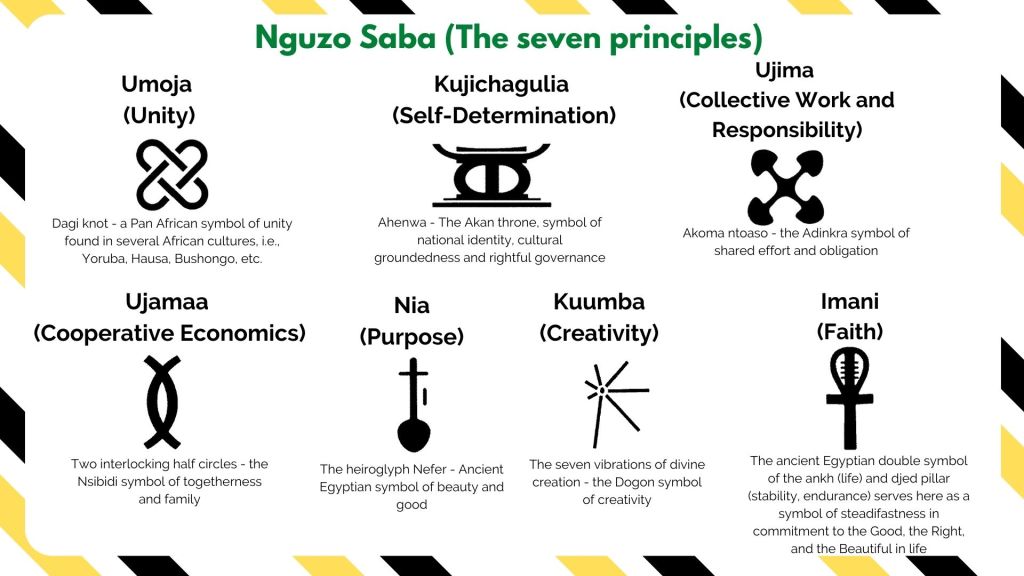
Like many holidays, Kwanzaa comes with its own set of principles. There are seven principles of Kwanzaa which originate from Swahili: Umoja (unity), Kujichagulia (self-determination), Ujima (collective responsibility), Ujamaa (cooperative economics), Nia (purpose), Kuumba (creativity), and Imani (faith). These seven principles are in place to affirm African heritage, community, and positive societal values. There are an additional seven symbols of Kwanzaa: fruits, vegetables, nuts, a straw mat, a kinara (candleholder), corn, gifts, a communal cup and seven candles. 

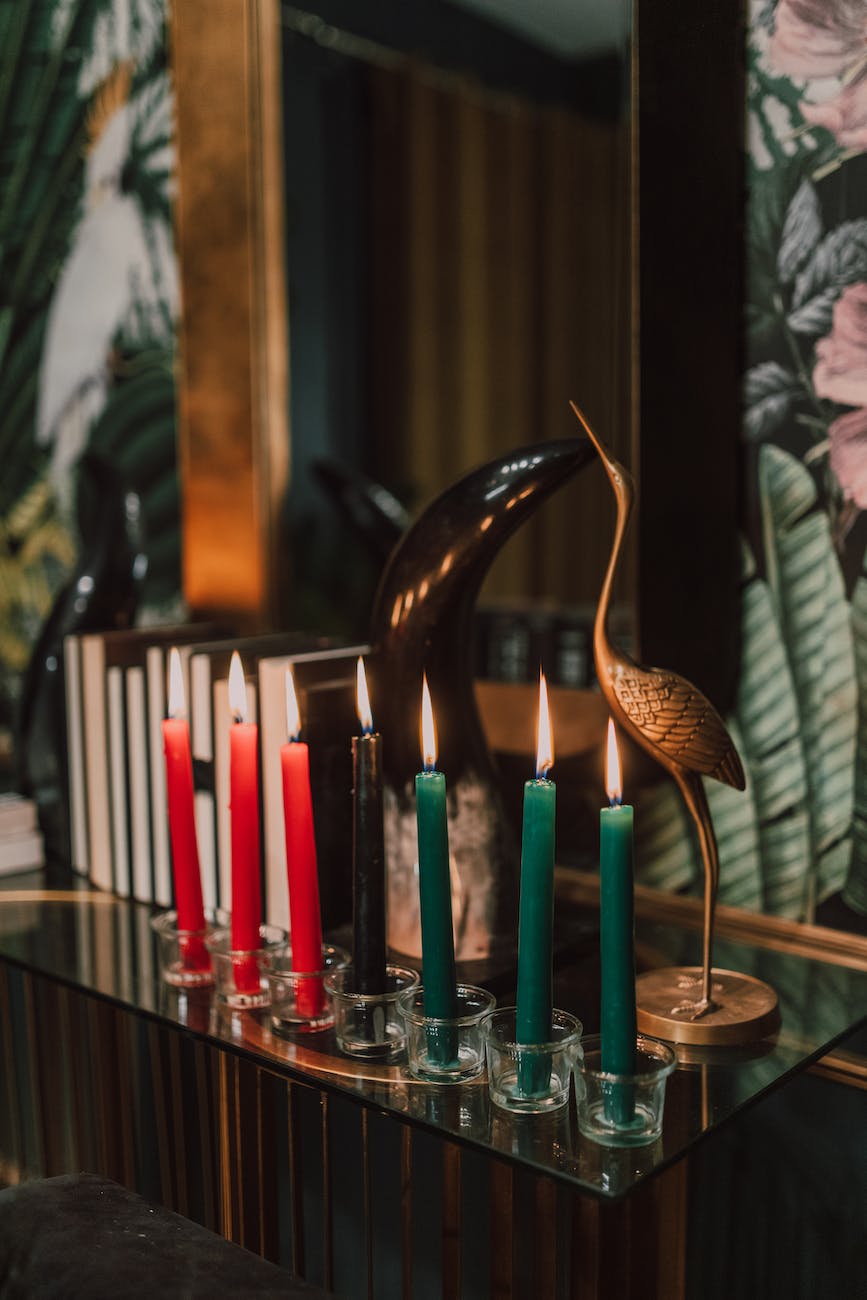
Kwanzaa is typically associated with the Pan-African colours of red, black, and green – these are the colours of the candles to symbolise the seven principles. Three of the candles are red, representing the struggle for liberation including the lives lost; one of the candles is black, representing people of African descent; three of the candles are green, representing the land and hope for the future. It’s common that celebrating families wear these colours, or decorate their homes in these colours.

On each day, the celebrating family comes together to light one of the candles in the candleholder and discuss the principle for the day. For example, on one day they may discuss the principle of Umoja (unity). On December 31st, families celebrating Kwanzaa join in a community feast known as the Karamu. Homemade and educational gifts are encouraged when celebrating Kwanzaa, which promote a closer family bond and sustainability, as they avoid commercialisation and promote deeper connections, consideration and thoughtfulness. Gifts when bought are related to culture, such as art, books, or music-related gifts with cultural significance, preferably from a business that is Black-owned. 

Kwanzaa places emphasis on community reflection and cooperation, as well as cultivating a habit of reflection and consideration towards others. The focus on community values, self-development and care towards yourself and others is one which makes it a great holiday for children to be introduced to. Alongside the promotion of positive values, it helps to affirm culture and heritage as people of African descent.

You can read Karenga’s annual address here

Will you be celebrating Kwanzaa this year? Let us know!

BLAM UK condemns the behaviour of Shortlands Station staff

On December 5, 2022, at Shortlands station, two young Black school children were harassed by rail staff and British Transport Police (BTP) officers.

Anti-Blackness from rail staff 

When considering the adultification of Black children by the establishment, this is a prime example. At no point can it be justified to have this number of adults restraining a child, regardless of the alleged ‘crime’ that may have been committed.The ratio of adult to child was unacceptable. Subsequently, the two brothers have first-hand racial trauma at an early age stripping away elements of their childlike innocence. Despite it being prohibited for the police to use force in a manner which results in degrading treatment or punishment. Such force was used against these Black children in a situation initially involving a forgotten free travel pass.

Following on from this brutality, the elder brother who was en-route school to undertake his GCSE mock exams was then detained and taken to a police station. His responsible adult, in this case his mother, was never informed. When his mother contacted Bromley Police Station, she was lied to and told he wasn’t there. This young boy sat in the police station alone for hours.

At BLAM we continue to campaign for Black children. We believe that Black children should be allowed to just be children, free from trauma and brutality. We are happy to offer our services to this family providing access to our cohort of therapists who have expertise in racial trauma. 

We are calling for communities based on care. The care manifesto reminds us that we have been encouraged to feel and act like hyper-individualised, competitive subjects who primarily look out for ourselves. In order to really thrive we need caring communities. We need localised environments in which we can flourish: in which we can support each other and generate networks of belonging. We need conditions that enable us to act collaboratively to create communities that both support our abilities and nurture our interdependencies.

Excerpt From: The Care Collective. “The Care Manifesto”. Apple Books. 

We understand that the British Transport Police have referred themselves to The IOPC (The Independent Office for Police Conduct). BLAM has very little belief in the IOPC’s ability to effectively identify the root cause of this treatment. Whilst the surface issue was the belief that the boys had committed fare evasion, the underlying issue that led to this horrific treatment was racism and anti-Blackness.We recognise that the height of the child coupled with his skin colour led officers to exhibit extreme force, the kind that would be used on a grown adult male. The adultification of black boys, and the ways in which society sees them as men, means that they are often subject to quite harrowing experiences by law enforcement. The deep-rooted perceived maturity of Black children means that an independent review simply isn’t enough. 

The parents should have been the first point of contact, not the police. The rail staff should be equipped to deal with these situations without escalating it further to an institution that continues to show it has no regard for young Black lives. Regardless of the alleged crime, all of the adults involved had a duty of care to these underage boys. A duty the institution has fallen short of time and time again. 

Therefore, we are calling for the firing of all those involved in this incident and for the abolition of the BTP. We are also calling for a review of policies and practices around dealing with young people on public transport. Any protocol that provides for the calling of the police on children in these circumstances is unjust and excessive. 

Not Everyday Shaku Shaku, Sometimes Adumu Adumu: Dance Cultures of Eastern Africa

Dance is a big part of life across the African continent. It serves many purposes; entertainment, enjoyment, religious rituals, celebrations, some are even used before warriors enter into battle. Whatever the dance is used for, the all share one characteristic – they are all very well structured and require a certain amount of talent to perform. Whilst West African dances are incredibly popular worldwide, dances from around Eastern Africa are less known (by those outside of those cultures), and so we’re here to help try and change that!

Adumu

It’s highly likely that you’ve seen this dance before but may not have known what it was called. 

The Maasai are a Nilotic group living in parts of Kenya and Tanzania. What does Nilotic mean, I hear you ask…

Nilotic adjective

1: of or relating to the Nile or the peoples of the Nile basin

2: of, relating to, or being the languages of the Nilotic people

The Adumu is part of the Eunoto ceremony which marks the transition from boy into fully fledged warrior man. It is an important rite of passage that has been performed for centuries. The Adumu involves the men jumping in the air to drums, chanting and clapping. They jump up with rigid straight backs and their heels aren’t allowed to touch the ground. It’s almost a competition, the higher the jump the louder the cheers from the crowd. 

Dhaanto

(Dhantur)

The Somali ethnic group are largely found in Somalia (obviously), but they can also be found throughout the Horn of Africa, including in Ethiopia. It is a Somali clan in Ethiopia that is thought to have first created the Dhaanto dance. The cultural folk dance is often played at celebrations and parties, it is an artistic expression of how the camel moves – how it walks, grasses and socializes with other camels – it is reflected in the dance moves. You see participants bobbing their heads and tapping their feet to the rhythm. It’s a very fun dance to watch.

Bwola

This dance is performed by the Acholi people of Uganda. The Acholi are a Nilotic (remember this term?) group, they can be found in both South Sudan and Uganda. The Bwola is performed by men only, after an intense training process in which they must learn the steps. The dance used to be performed by warriors upon their victorious return to their village, however in more recent times it is reserved for special, royal occasions such as the swearing in of a new chief, or funerals and weddings. Elaborate headdresses are worn and sticks are used to imitate the spears warriors would’ve once used. 

All of these dances are still performed regularly today, and it is important that we continue to document them as they are important cultural histories that should be preserved and protected. And maybe one day, they’ll be incorporated into the mainstream party scene. Imagine people doing the Adumu during the Afrobeats set at a rave, that would be a sight to behold!

The Artistic Tradition of Yoruba Culture & Art

By Pamilerin Thompson

The arts of the Yoruba are as numerous as our deities, and many objects are placed on shrines to honor the gods and the ancestors. Beautiful sculptures are made from wood and brass and the occasional terracotta. The Yoruba also have varied masking traditions that have resulted in a great diversity of mask forms. Additional important arts for the Yoruba include pottery, weaving, beadworking, and metalsmithing.

The Yoruba people are a Nigerian ethnic group that inhabit West Africa. Today, they are found around the globe but historically resided in what is now known as Nigeria, Benin, and Togo. These areas constituted what was once known as ‘Yorubaland’. Additionally, in oral history, the origin of the Yoruba peope can be traced back to their ancient father and divine Oduduwa who migrated from an ancient city now known as Mecca.

‘BENIN BRONZE HEADS’

The most widely known piece of Yoruba art are the ‘Benin Bronze Heads’ also known as the ‘Benin Bronzes’, but they should not be confused with the ‘Ife Head’ (or ‘Bronze Head from Ife’) which has a slightly diffrent history of dishonest appropriation. 

The ‘Benin Bronzes’ are a group of thousands of objects that were taken from the Kingdom of Benin, in what is now Nigeria, in 1897. (Their exact number is unknown, though it is believed to exceed 3,000 and reach up to 5,000.) These objects—including figurines, tusks, sculptures of Benin’s rulers, and an ivory mask—were looted by British troops, and have since been dispersed around the world, with the bulk of the works now residing with state museums in Europe. Contrary to the name, not all of the works are made of bronze. Because they made their way beyond West Africa as a result of a colonial conquest, the Benin Bronzes have faced calls for their return, both within Nigeria and outside it. There are over 900 objects from the historic Kingdom of Benin in the British Museum’s collection, the most in any institution around the world.

Benin suffered a bloody and devastating occupation. No exact figure can be given for the number of Benin’s population who were killed in the conquest of the city. However, it is clear that there were many casualties during the sustained fighting. The occupation of Benin City saw widespread destruction, looting, and pillage by British forces. Along with other monuments and palaces, the Benin Royal Palace was burned and partly destroyed. Its shrines and associated compounds were looted by British forces, and thousands of objects of ceremonial and ritual value were stolen to the UK as official ‘spoils of war’ or distributed among members of the expedition according to their rank. This included objects removed from royal ancestral shrines, among which were ceremonial brass heads of former Obas and their associated ivory tusks. The looted objects also included more than 900 brass plaques, dating largely to the 16–17th century, found in a storage room within the palace. Having previously decorated the palace walls, these plaques were key historic records for the Benin Court and Kingdom, enabling illustration of historic practices and traditions. Following the occupation, the Oba was later captured and sent into exile, while a number of Benin chiefs were executed. Justified as legitimate military action against a ‘barbarous’ Kingdom, this brutal, violent colonial episode effectively marked the end of the independent Kingdom of Benin.

Nevertheless, the modern city of Benin (in Edo State) is the home of the current ruler of the Kingdom of Benin, His Royal Majesty Oba Ewuare II. Many of the rituals and ceremonies associated with the historic Kingdom of Benin continue to be performed today. Despite the brutal and imperialistic attack by British colonial forces the traditions and cultures they aimed to destroy and wipe out have prevailed through oral hisory.

‘Benin Bronzes’ were created from at least the 16th century onwards in the West African Kingdom of Benin, by specialist guilds working for the royal court of the Oba (king) in Benin City. The Kingdom also supported guilds working in other materials such as ivory, leather, coral and wood, and the term ‘Benin Bronzes’ is sometimes used to refer to historic objects produced using these other materials.

Many pieces were commissioned specifically for the ancestral altars of past Obas and Queen Mothers. They were also used in other rituals to honour the ancestors and to validate the accession of a new Oba. Among the most well-known of the ‘Benin Bronzes’ are the cast brass plaques which once decorated the Benin royal palace and which provide an important historical record of the Kingdom of Benin. This includes dynastic history, as well as social history, and insights into its relationships with neighbouring kingdoms, states, and societies. 

In October 2021 the British Museum received a written request for the return of ‘Nigerian antiquities’ from the Federal Ministry of Information and Culture, Nigeria. In addition, representatives of the Benin Royal Palace have made various public statements asking for the Benin collections to be returned, most recently at the Benin Dialogue Group meeting hosted by the Museum in October 2021. In spite of these recent requests and several other requests over the decades the only institution who has committed to repatriating a ‘Benin Bronze’ work is the the University of Aberdeen in Scotland who called its 1957 acquisition of a sculpture of the Oba at auction in London ‘extremely immoral’ and has vowed to send the work home. 

As artist Victor Ehikhamenor, wrote in his New York Times op-ed on the subject in 2020 ‘[g]enerations of Africans have already lost incalculable history and cultural reference points because of the absence of some of the best artworks created on the continent. We shouldn’t have to ask, over and over, to get back what is ours.’

We join the many others who continue to call upon and demand that the British Museum and other institions located in the Global North return stolen artefacts to their rightful homes in Africa.

IFE HEAD

The Bronze Head from Ife, Wunmonije Heads, or Ife Head, is one of eighteen copper alloy sculptures that were unearthed in 1938 at Ife in Nigeria, the religious and former royal centre of the Yoruba people. It is believed to represent a king. It was probably made in the fourteenth-fifteenth century C.E. Like most West African ‘bronzes’ the Ife Head is actually made of copper alloyed with other metals, described as ‘heavily leaded zinc-brass’. Modern practice in museums and archaeology is increasingly to avoid terms such as bronze or brass for historical objects in favour of the all-embracing ‘copper alloy’. The Head is made using the lost wax technique and is approximately three-quarters life-size, measuring 35 cm high. The artist designed the head in a very naturalistic style. The face is covered with incised striations, but the lips are unmarked. The headdress suggests a crown of complex construction, composed of different layers of tube shaped beads and tassels. This decoration is typical of the bronze heads from Ife. The crown’s surface includes the remains of both red and black paint.

The Ife Head was found by accident in 1938 at the Wunmonije Compound, Ife, during house-building works amongst sixteen other brass and copper heads and the upper half of a brass figure. Most of the objects found in the Wunmonije Compound and neighbouring areas ended up in the National Museum of Ife, but a few pieces were taken from Nigeria and are now in the collections of major museums. This pictured Ife Head was taken from Nigeria by the editor of the Daily Times of Nigeria, H. Maclear Bate, who probably sold it to the National Art Collections Fund, which then passed it onto the British Museum in 1939.

The Ife Head is thought to be a portrait of a ruler known as an Ooni or Oni. It was probably made under the patronage of King Obalufon Alayemore whose famous naturalistic life-size face mask in copper shares stylistic features with this work. Today among the Yoruba, Obalufon is identified as the patron deity of brass casters. The period in which the work was made was an age of prosperity for the Yoruba civilisation, which was built on trade via the River Niger to the peoples of West Africa. Ife is regarded by the Yoruba people as the place where their deities created humans.

The excavation of the Ife Heads had a massive impact on art history which for years racistly argued that the Ife Heads were an anomaly and had been cast by a colony of ancient Greeks in thirteenth century BCE. This is now widely understood as stemming from colonial racism and the Ife Heads are not only representative of inigenous African traditions, they were likely created by a highly talented indiviual artist in a single workshop.

PRINCESS ELIZABETH OLOWU

Princess Elizabeth Olowu is a sculptor who is recognised as the first female bronze caster in Nigeria. Born in 1939 in the royal house of Benin to Oba Akenzua II, Olowu took interest in the objects in the royal court—Benin Bronzes—and started learning the skill of bronze sculpting alongside her mother.

Olowu’s focus and desire to learn the skill of bronze sculpting was encouraged by her father—at a time when women in Benin were not allowed to participate in the craft. She was educated at Holy Child College, Lagos and in 1966, she enrolled at the University of Nsukka to study Fine Arts. Her artistic abilities and academic performance earned her the top first-year student award in Fine Arts but her education at Nsukka was cut short because of the Biafran War.

In 1976, she enrolled at the newly established department of Creative Arts at the University of Benin, where she graduated as the department’s first sculpture major in 1979. In 1984, she became the first female recipient of a Master’s of Fine Arts from the University of Benin and was recognised as Nigeria’s first female bronze caster. She was awarded the Bendel State Award for Art and Culture in 1985.

Art has always held massive cultural importance and value in the Yoruba cultural tradition. It depicts history, social standing, remembers royalty, celebrates life and death, and is a part of our traditional attire. Everything from ancient bronze antiquities to the gele and adire we tie. Yoruba culture is infused with a rich artistic history. The lasting impact of Yoruba art and culture on  global art history cannot be understated!

Mami Wata, La Sirene, Mama Dlo

Mermaids in African & Caribbean Mythology

By Michelle

The myth of the mermaid is a universal cultural staple. They feature in fairytales, fantasies, adventures, and the like. The concept of mysterious beings who live in the sea and other bodies of water has captivated the minds of those who live on land for milenia. The myth of the mermaid is layered, diverse, and dynamic. This can be attributed to the fact that the myth varies from culture to culture, and even by region on the same continent. Like other mainstream mythological creatures, mermaids have roots in many cultures around the world, from China to Russia to Senegal – several cultures across the world have legends of these aquatic beings. In this blog, we will be exploring the long-standing mermaid mythology of Africa and the Caribbean.

Although they may be referred to by different names, plenty of what we would call mermaids around the world have the same, or at least similar, physical traits. Many of them feature a being with the upper body of a woman and the elongated bottom half of a fish, with a tail and fins replacing legs. In West and Central-West Africa, mermaids are generally referred to as Mami Wata, a name which has unclear origins. This blanket name refers to mermaids, and the deity which resembles a mermaid.

Since the myth of the mermaid is one that features in so many cultures across the world, it is no surprise that the appearances of mermaids vary. Despite the popularised image of mermaids being white, Black people have always had their mermaid myths and legends albeit without the involvement of tridents, princes and ‘happily-ever-afters’. Black countries in Africa and the Caribbean in particular have a unique relationship with the myth of the mermaid. Generally, in these areas, those who live near bodies of water (rivers, lakes, seas) are aware of her existence. Reactions on mentioning Mami Wata could range from wariness to indifference, the sort of indifference that comes from talking about something that is a known fact or a part of life. 

Interestingly, it is also generally agreed upon that mermaids are inherently supernatural, with equally supernatural abilities such as hypnosis. In West and Central West Africa, Mami Wata is not only the blanket name for mermaids – it is also a deity, meaning that there are people who worship her. She has a multitude of abilities, including healing the sick, increasing female fertility by ‘blessing’ women with baby girls, as well as providing wealth and other material rewards. As a goddess, she is described as jealous with a potentially fatal wrath when angered. She can also cause sickness, and bad luck which ranges from failure in important aspects of life, to the more drastic – death. There is a certain unpredictability associated with mermaids and Mami Wata, who is said to be hostile and dangerous at times and welcoming at other times. There are some aspects of her lore which involve luring men to their graves – similar to European mermaid myth. However, unlike the European mermaid myth, African and Caribbean mermaid mythology can be argued as being more complex as mermaids in these places are believed to have supernatural abilities, are worshipped, and are associated with curses and blessings.

Mami Wata is said to favour women and seek them out to ‘bless’ or influence them to worship her. Her priests are also commonly women, high priestesses who dedicate their lives to her worship. She, and other mermaids in general, are also referred to as water spirits. It is important to remember that she is an integral part of lore and is a vital part of traditional religions in the continent as well as variations and denominations that were created in the African diaspora, particularly in the Caribbean. She is associated with good luck, fertility, beauty, material gain, success, and the like and is said to bestow these to her followers. Mami Wata and mermaids in general are feared and revered by many people, but they are also a source of captivation due to the mystery that surrounds them. Although they are the subjects of fairy tales, mermaids are very real to many Black communities. In some of these communities they are responsible for random drownings, disappearances and other sudden and inexplicable events. It is common to hear anecdotes about them, about a strange and mysterious beautiful woman who offered children, wealth, and beauty to another woman, or about a mysterious being who was trying to beckon someone, and so on.

During the Transatlantic Slave Trade, enslaved Africans who were kidnapped and sold into slavery carried their religions, practices and folklore with them to their destinations. As mentioned earlier, Mami Wata is a deity who has been worshipped for an immeasurable amount of time. As she is also heavily associated with rivers, lakes, and seas it was no wonder that her legend quickly spread into the Caribbean with the arrival of enslaved Africans who wished to preserve their religions and myths. Interestingly, she is not the only deity to have been transported into the Caribbean and the Americas. The Ghanaian deity and folklore character of Anansi, who is commonly represented as a spider, was another deity worshipped and incorporated into folklore in the Caribbean with African roots. Although she may also be called La Sirène in the Francophone parts of the Caribbean, she is still venerated in a very similar manner that she is in Africa.

Mermaid imagery is commonly used in art in Africa, particularly along the West African coast. They usually represent Mami Wata. It is not unusual to see her image in a mural outside of buildings such as gambling houses, temples, and other general buildings. She is commonly depicted with a comb or handheld mirror (sometimes, even a combination of the two) which are symbols of beauty and vanity. In addition to this, her image is also associated with snakes. She can be depicted with a large snake draped across her shoulders, or carrying one above her head. In African and Caribbean lore, Mami Wata has the ability to shapeshift, but it’s said that her preferred form is a beautiful young woman. She also has the ability to turn into a large snake, hence why she is associated with them.

There has been more of a discussion about the appearance of mermaids and a subsequent dive into their diversity. As mentioned earlier, the mermaid is a universal cultural staple – it features in several cultures around the world, particularly those in countries with coastlines. Mermaids do not have a default appearance, and they do not all have features commonly associated with white Europeans. The mermaid myth in Black countries is ancient, rich, and complex. Mermaids, particularly the deity Mami Wata, are venerated as well as feared. Her lore and status was transported during the Transatlantic Slave Trade and spread across communities of people of African descent. Although the image of mermaids that is mainstream and widely popularised in film and other media does not resemble Black people, Black people have always had mermaid myths and legends which are rich, layered, and longstanding.

Black Music as a form of Protest

By Michelle Aboagye

What makes protest so impactful and so effective is its versatility. Protest comes in many shapes, forms and mediums, and as seen through history it can be inspired from even the smallest events. Protest is a human response to unpleasant and unfavourable conditions. Protest can be something as unifying as taking to the streets in rallies or demonstrations, something more individual such as a hunger strike, or even something more conceptual like an art piece. Certainly, the arts have always been a readily-available form of protest. An abstract art piece, calls to action in song lyrics and more are some of the common ways the arts can be used as mediums of protest. 

As for why the arts are used as mediums of protest, the reasons could be many. Perhaps the main reason is because participating in the arts often allows us to express ourselves in ways that our everyday lives are not able to. These can be our ways of life, our obstacles in life, and the things that are imposed on us. The arts place an emphasis on the unpleasant conditions we face. This is particularly the case for Black people and our relationship with music. Music for Black people has always been a means of expression and celebration on one hand, and a means of maintaining hope and inspiring protest on the other. The list of music genres which have protest embedded in them is endless and includes soul, reggae, hip-hop, and samba. In this blog post, although we will explore some music genres as a whole, we will also shed light on samba and its unique origins.

When you think of soul, you usually think of smooth voices, soulful, deep melodies and elements of jazz. Popularised in the 1950s and 60s and African American in its origins, soul music was more than this. It also touched on social issues that impacted Black Americans during the time, particularly the Black American Civil Rights Movement. Soul singers such as Nina Simone placed emphasis on racial injustice Black Americans faced in her lyrics, and she was a strong supporter of the Civil Rights Movement. In fact, one of her most famous protest songs Mississippi Goddam was written after harrowing events in Black American history, namely the 16th Street Baptist Church Bombing of 1963 which saw the death of four young Black girls in a white supremacist attack and the assassination of civil rights activist Medgar Evers in Mississippi that same year. After its debut in 1964, there were several complaints over the song. Many complaints stated that it was in ‘poor taste’.

By writing and performing Mississippi Goddam, Nina Simone drew attention to how Southern American states subjugated Black Southern Americans with their degrading and dehumanising Jim Crow laws and their hostility to Black Americans. She would change the original lyrics of Mississippi Goddam that mentioned Tennessee to other places such as St Augustine and Selma to raise awareness or honour whatever civil rights-related events or moments occurred around the time. An excerpt of lyrics from Mississippi Goddam can be found below:

“Alabama’s gotten me so upset 
Tennessee made me lose my rest 
And everybody knows about Mississippi goddam
Hound dogs on my trail 
School children sitting in jail 
Black cat cross my path 
I think every day’s gonna be my last 
Lord have mercy on this land of mine
We all gonna get it in due time 
I don’t belong here”

Mississippi Goddam, Nina Simone, 1964

Mississippi Goddam also critiques the slow pace in which change is enacted in America, and justice is received for those who deserve it. Nina Simone would later recall the song as being her “first Civil Rights song” and that the song “erupted out of her quicker than she could write it down”. Other songs of protest that Nina Simone made include I Wish I Knew How It Would Feel To Be Free and Why? (The King of Love Is Dead) which was a tribute to Dr. Martin Luther King Jr. after his assassination 1968.

Aside from soul, another Black music genre which has resistance and protest embedded in its lyrics is rap music. Rap music, alongside its call to action of resistance and critique of institutions which oppress Black people, also sheds light on power, communication, and Black cultures. It also helps to capture sentiments and gives a platform to the experiences and lives of Black people who live in inner city areas and areas with high levels of deprivation. Rap music sheds light on socio-economic issues and gives a voice to Black people who are often ignored. It is a medium of identity, solidarity, and critique of corrupt institutions, such as policing. 

Certainly, across the diaspora, Black people have pioneered genres that amplify their protests. This is also the case in South America, where enslaved Africans and their descendants pioneered music like samba, rumba, cumbria, and tango across the continent. Samba in particular has a long, rich history with origins in enslaved Afro-Brazilian communities before it gained popularity in Rio de Janeiro. This history is one which involves the bravery and persistence of an Afro-Brazilian woman called Hilária Batista de Almeida, but known by her community as Aunt Ciata or ‘Tia Ciata’ as she would have been called in Portuguese. 

Tia Ciata arrived in Rio de Janeiro around 1876 at the age of 22. In this time, Rio was a busy and bustling Latin American capital that attracted working class people from neighbouring countries, Latin Europeans such as those from Portugal, and Afro-Brazilians from the north-eastern region of Bahia. They sought better living conditions and opportunities that an international city such as Rio could provide. Tia Ciata was one of those Afro-Brazilian migrants searching for a better life. Upon moving into a neighbourhood known as Little Africa due to the large presence of Afro-Brazilians, she would later become one of the ‘aunts’ or ‘tias’ that helped to shape her community, and be recognised by many to be the patron and custodian of samba.

Samba involves the use of instruments such as a range of drums, bells, tambourines and other percussion instruments. It uses rhythmic patterns and melodies, and even has its own accompanying dance of the same name. It was pioneered by enslaved Africans in Brazil. Tia Ciata would bring the culture she inherited from her African ancestors with her to Rio. During the day, she would sell her homemade Bahian delicacies on the streets of Rio, and at night, her home would act as a cultural hub of sorts, hosting samba parties in her back garden and worship gatherings – sometimes the former would even be disguised as the latter to avoid prosecution! Samba parties were a place to meet others, mingle, dance, eat, and drink. It is worth noting that at the time, there were no dedicated public spaces for Afro-Brazilians and poor people to socialise and interact, so family homes became hubs and meeting places.

Although today, samba is synonymous with Brazilian culture it was once heavily policed by the Brazilian government. Samba musicians were frequently arrested and had their instruments destroyed or confiscated, and samba parties were often shut down. The Brazilian government restricted expressions of Afro-Brazilian culture. This did not stop Tia Ciata however. Her parties became renowned in Rio, and she became smarter at evading police as she hosted more parties by disguising parties as religious gatherings. Her parties also transcended ethnic barriers, with working-class Jewish people, Latin Europeans and more participating in the festivities. At times, her parties would even last for five, even seven days! She hosted some of the most famous musicians of her time and even participated in one of the earliest recorded hit samba songs ‘Pelo Telefone’ between 1916 and 1917. 

All things considered, it is no wonder Tia Ciata is hailed as the patron of samba and its custodian. Today, samba is an integral part of Brazilian culture despite this not being the case 100 years ago. Her bravery and persistence in maintaining and sharing the culture of her African ancestors ensured that samba was not a forgotten or erased practice.

Black music has often served multiple purposes, but one of its most impactful uses is as a medium of protest. From Tia Ciata in Brazil, to Nina Simone in the US. Across the Black diaspora, Black people have used music as a means to resist and call others to action. As history continues to unfold, we will always look forward to seeing how music evolves and what points of protest we will make.

Black Countries, Indigenous Communities, and Climate Change 

By Michelle Aboagye

Over recent years, the climate change debate has permeated all aspects of life, particularly in the media and amongst non-governmental organisations (NGOs). The reporting of several of the Extinction Rebellion protests from 2019-2022, as well as the continuous platforming of climate change sceptics in the media may have contributed to the popularity of the climate change debates in society today, yet some key points continue to be left out. This blog will explore these forgotten key points, namely how Black countries are affected by climate change and how indigenous communities protect their environments and adapt to climate change. 

Climate change refers to the long-term shifts in weather patterns and temperatures. Although these shifts can be natural, industrial activity in the 1800s and other human activity involving coal, oil, and gas have been the main drivers of global climate change around the world. Since the Earth works as a well-connected system, weather and climate changes in one area affects others. It is therefore important to not think of climate change as an issue that affects specific groups, but as an issue that ultimately affects everyone. Today however, it is clear that the climate crisis does not affect everyone to the same degree. 

For example, Africa and the Caribbean among others are disproportionately affected by the climate crisis despite generally contributing very little in comparison. The 10 largest greenhouse gas-emitting countries, which include countries such as the US and China, contribute 68% of global emissions, whereas the 100 least emitting countries (which include countries from Africa and the Caribbean) altogether contribute 3% of global emissions. Despite the great difference in contributions, the climate crisis disproportionately impacts Black countries and impacts their way of life.

In the Caribbean, higher intensity hurricanes will be more frequent, as some of the area is located in a hurricane alley where hurricanes form. This was seen with the Category 4 Hurricane Matthew in Haiti in 2016 which left more than 1 million people in need of humanitarian assistance. Climate change is also causing extreme weather in both Africa and the Caribbean in the forms of intense droughts, flooding, higher intensity tropical storms, and longer dry seasons due to reduced rainfall. Climate change ultimately affects the health, security, livelihood, and food and water systems of people in Africa and the Caribbean, and makes them more vulnerable. 

In fact, those who have contributed the least to the climate crisis actively care for and protect the environment, and have their own practices which ensure sustainability. Indigenous communities have always had ways of protecting their environments and promoting environmental consciousness, which can be described as being mindful of how your actions impact the environment. Indigenous African communities in particular have taboos, folklore, customs, traditions and more associated with the natural environment in order to ensure its protection and the promotion of environmental consciousness amongst its members. Many indigenous communities accept that the environment ‘came before them’ and that they must treat it with care and respect.

The Busua and Axim people of Ghana have taboos associated with fishing in bodies of water (rivers, lakes, and seas), with the most widespread taboo being fishing on Tuesdays and cleanliness. This is mainly out of respect for sea gods, and it also allows for the repopulation of sea creatures and gives fishermen a chance to mend their tools. In these communities, the sea and other water bodies are regarded as an entity who demands respect and consideration. Because of this, the sea and its gods are said to dislike people who are not clean (physically and spiritually) and people who participate in activities that pollute the sea. Failure to follow these customs can result in punishments in the form of fines or even the threat of angering the sea gods. This anger is believed to manifest as general bad luck, a lack of success in fishing, or even health issues.

Although they come with a risk of punishment, these taboos effectively promote environmental consciousness and sustainability. The existence of these taboos, customs, traditions, and more display that environmentalism is a strong aspect of indigenous cultures. Moreover, indigenous communities are societies that have interacted extensively with their environments and passed this knowledge on orally over generations. These communities are recognised to have unique relationships with their natural environments and hold indigenous knowledge. This refers to the understanding and know-how that is collected and shared over generations of native communities. It guides these societies in all their interactions with their environment. Things such as values, beliefs, culture, languages and more affect indigenous knowledge.

Indigenous African farmers, elders and community leaders, for example, tend to hold deep knowledge about their climate, weather patterns, and its variations. This knowledge has been collected over several generations by observing natural phenomena and the natural environment, such as observing moon phases and colours, constellations, animal behaviour, and more. Idigenous African communities are already observing the impacts of climate change mentioned earlier, such as longer dry seasons, shorter rainy seasons and rainfall that is harder to predict.

Although the effects of climate change present unique problems to these communities, they continue to display their resilience and readiness to adapt by continuing to observe the effects of climate change in order to respond by planning and implementing the ways they will adapt. When the higher-intensity storms occur and cause flooding, indigenous communities in Swaziland observe the behaviour of the local emahloko birds as a warning sign to alert them to the possibility of flooding. When the emahloko birds’ nests are low in the trees, that tells them the chance of flooding is low, and when they are higher up this alerts them that flooding is very likely. Although indigenous communities have developed responses to the effects of the climate crisis, more support from national governments in the forms of policies and other activities are necessary to maintain their efforts.

The Emahloko bird aka Ploceus xanthops

The effects of climate change and the climate crisis disproportionately affect Black countries of Africa and the Caribbean, although their native populations have environmental protection, consciousness, and sustainability ingrained in their cultures. Today, many people do not realise that Black people and communities will be more affected by the climate crisis as it will impact their livelihoods, food systems, health, security, and more. Urgent action in the form of policies and awareness is necessary to help mitigate these effects. These are also talking points that must be included in the climate change debate.

The history of Black Hair

By Christivie

Black hair was and still is used as a tool for resistance.

Black hair is a very important part of Black culture. Black hair is beautiful, Black hair is elegant and Black hair is proud. Black hair is not easy to define as Black hair comes in different shapes, styles and sizes. Different Black hair styles tell a story within itself, a story that speaks volumes about the Black experience and identity.

Hair is a significant part to each individual’s appearance, however Black hair goes beyond appearance and looks. Black hair has a uniquely meaningful history as a symbol of survival, resistance and celebration. It has been wielded as a tool of oppression and also one of empowerment—and our society’s perceptions of Black hair still affects how Black people are treated today. 

In pre-colonial African societies, Black hair was seen as a symbol of a person’s identity. Popular styles like braids, twists and dreadlocks were used to symbolise a person’s tribe, social status and family background. During the Transatlantic slave trade, slave owners forcibly transported people from West Africa to colonies in modern-day Brazil and throughout the Americas, some African women, namely rice farmers, braided rice seeds into their hair as a means for survival of themselves and the culture of their homeland. Enslaved Africans also used cornrows to transfer and create maps to leave plantations and the home of their captors. Black hair was used as a tool for resistance.

Watch this video to learn more about the importance of hair throughout Black history

Hair types

Hair in general is split into four categories: Type 1 usually describes straight hair; Type 2 signifies wavy hair; Type 3 refers to curly hair and Type 4 symbolises kinky hair. 

Type 3 and 4 are the usual hair texture types for Black people. Black people who have Type 3 hair has S shaped bouncy curls that are well defined, dry and slightly rough. As Black hair is very complex, Type 3 and Type 4 hair have their own subtypes ; 3a, 3b and 3c. 3a curls are springy and have a definite S shape. This hair type can be straightened easily and is normally shiny and not too dry. 3b hair ranges from springy ringlets to tightly wounded and convoluted corkscrews. It has a lot of frizz that can be reduced by regular oiling using olive or coconut oil. Lastly, 3c hair is best described by wiry, coarse and frizzy corkscrews that are quite hard to untangle and sometimes difficult to straighten. However, by using excellent quality hair products containing organic ingredients like coconut milk, soy protein and Shea butter, you can maintain the health of type 3c hair. 

Type 4 hair is generally known as kinky hair which again can be categorised into three subtypes: 4a, 4b and 4c. 4a hair is extremely coiled and shows an S-shaped pattern. This hair type can range from being wiry and frizzy to smooth and fine-textured. The 4b hair type displays a Z-shaped pattern. This hair type has tightly wounded corkscrews that are short, springy, and quite coarse too. They have lesser moisture compared to type 4a. Type 4 hair is also referred to as kinky, or coarse hair and is characterised by its tight, dense texture and natural lift. The volume that comes with type 4 hair is caused by its unique curl pattern. Every Black person has a unique hair texture!

For a long period of time Black hair has been condemned rather than celebrated. Slave owners would shave off Black people’s hair, in an attempt to erase their identities. Slaves were forced to hide their hair throughout the week and were only given the luxury to show their hair on Sundays.

In the 1950s, it wasn’t uncommon to meet a Black woman with chemically-straightened hair in the United States and Britain, as this was what was socially-acceptable at the time. Black hair was not celebrated and it was seen as ‘easier’ to maintain than natural hair. Relaxers and other chemicals were more readily available than products for natural hair.

Racist oppression led Black people to believe their hair is ‘bad’, whilst ‘good’ hair is slinky, smooth, straight. In other words, caucasian! Black hair is beautiful and bold. It represents strength.

Black hairstyles

Black Hair Styles continue to evolve. Admired hairstyles such as braids, dreadlocks, cornrows and bantu knots didn’t just appear from nowhere, in fact these hairstyles date back to our African ancestors. Dreadlocks have a long history in Africa. Victoria Sherrow, the author of the Encyclopedia of Hair, A Cultural History, named the priests of the Ethiopian Coptic Orthodox Church as some of the first people to have sported dreadlocks in Africa, as early as 500 BCE.

The origin of braids can be traced back 5000 years in African culture to 3500 BC—they were very popular among women. Braids are not just a style; this craft is a form of art. The popular cornrow hairstyle which now comes in variations, dated as far back as 3000 B.C., particularly in the Horn and West coasts of Africa. In the early 1500s, the style was used as a communication medium amongst various African societies that were later forced to migrate to the Americas as slaves, where their customs followed. Bantu knots can be traced back to the 2nd millennium BCE through 1500 CE to what at the time was the Bantu speaking community that originated from Southern West Africa and spread out through Central, Eastern & Southern Africa during the Bantu migration. 

As mentioned previously, Black hair can be associated with many negative connotations deep rooted in racism and westernised oppression. However it is ironic how Black hairstyles have been stolen and culturally appropriated; we now see cornrows, braids and other hairstyles worn by caucasion celebrities. Many may argue it is ‘just a hairstyle’ or make the ridiculous comparison of Black women wearing weaves and wigs. Black people use extensions, weaves and wigs as protective hairstyles. Non-Black people sport Black hairstyles because it is a current trend, they don’t understand the history or the significance of Black hair. Take Kim Kardshian for example, in 2018 she posted a picture in Fulani braids and the world credited her and named them ‘Kim K Braids’, when responding to the backlash Kim K stated ‘It’s just a hairstyle’.

 Fulani Braids is not just a ‘hairstyle, Fulani or feed-in braids originate from the Fulani (Fula) people in West Africa and the Sahel region. The large, nomadic community passed on the traditional hairstyle through generations of women. Known for its length and unique patterns, this style features braids that hang or loop on the sides of the head.

Black men hairstyles are also a representation of self expression. Black men can have a range of different hairstyles from classic cut fade to coloured dreadlocks. Take a look at 4 popular Black men hairstyles-

– Twists are a simple protective hairstyle worn by Black men.

– The classic low cut fade, achieved with great skill and precision.

Dreadlocks also known as ‘dreads’ or locs is a staple Black man hairstyle. Made popular by the Jamaican Reggae artists, the hairstyle is also widely worn by many Black rappers, athletes and socialites in the US & UK. They can be versatile in so many ways; they can be long or short; you can colour them to your own preference and style them in different ways.  Those who belong the Rastafari faith also believe that dreadlocks are a way to keep themselves in a pure state of nature as God intended. 

A curly hightop is a haircut which is cut low on both sides of the hair and curly hair is left in the centre of the head. This hairstyle dates back to the 80s when Jheri Curls were popular in the black community. To achieve this look you can use your natural curls, a curly/jheri perm or a special sponge found in local hair shops.

Black men’s hair can also fall victim to cultural appropriation. We often see non-Black people with cainrows, locs and even fake afro hightops. Here’s an example


BLAM’s Top Hair Tips

Afro-Caribbean hair is delicate and tends to be very dry. As a result, special care needs to be taken to ensure its health and vitality. These are BLAM’s top tips for both women and men;

  • Have knowledge on what products work best for your hair type. It may be a lot of trial and error at first, so speaking to a professional is advised
  • Moisturise and massage your scalp with hair oils daily. Research which oils do what. 
  • Wash days can be exhausting however, deep conditioning will give your hair a real boost of moisture and feed the strands from the inside out. 
  • Use sulphate free shampoos to avoid hair and scalp getting dry 
  • Protect your hairstyles with a silk scarf of a silk bonnet before bed (or if you’re a rough sleeper, invest in silk pillow cases)
  • Lastly, have fun with your hair! Don’t be afraid to experiment with it. It’s just hair and will grow back, express yourself

Your hair is your crown, be proud of it!

Urgent Human Rights violation trigger sent to United Nations for the Police Killing of Chris Kaba

 BLAM UK Founder sends an urgent warning to UN Human Rights experts and committees

Dear UN CERD Committee and UN Experts,

My name is Ife Thompson, I am a Criminal Defence Pupil Barrister, a Community Activist, Founder of BLAM UK and a United Nations Fellow for PAD 2020.

I am emailing to highlight the fatal police killing of Chris Kaba a young 24-year-old Black Man that took place in the UK. Chris Kaba was shot dead by UK armed police whilst still in the car and unarmed, after a police chase. The car he was driving was not registered to him, so the police did not know who was in the car during the police chase. The police killing took place on Monday 5th September 2022 in the late hours of the evening. This is the second death of a Black man after police contact with the Met Police this year, the first one being Oladeji Omishore.

The police killing of Chris Kaba engages the following international human rights violations under the Convention against Torture and Other Cruel, Inhuman or Degrading Treatment or Punishment, International Covenant on Civil and Political Rights and of the International Convention on the elimination of racial discrimination.

Under Article 16 of the UN Convention Torture and Other Cruel, Inhuman or Degrading Treatment or Punishment prohibits “other acts of cruel, inhuman or degrading treatment or punishment which do not amount to torture as defined in article 1…” The former U.N. Special Rapporteur on Torture, Theo van Boven, noted that the misuse of weapons, such as batons, stun guns, shields and belts, and tasers, and chemical control substances, such as tear gas, can amount to “torture or other forms of ill-treatment.” 

Article 6 § 1 of the International Covenant on Civil and Political Rights provides: “Every human being has the inherent right to life. This right shall be protected by law. No one shall be arbitrarily deprived of his life.”

In this connection, the Human Rights Committee of the United Nations noted the following (see General Comment no. 6, Article 6, 16th Session (1982), § 3): “The protection against arbitrary deprivation of life which is explicitly required by the third sentence of Article 6 § 1 is of paramount importance. The Committee considers that States Parties should take measures not only to prevent and punish deprivation of life by criminal acts, but also to prevent arbitrary killing by their own security forces. The deprivation of life by the authorities of the State is a matter of the utmost gravity. Therefore, the law must strictly control and limit the circumstances in which a person may be deprived of his life by such authorities.”

The United Nations Basic Principles on the Use of Force and Firearms by Law Enforcement Officials (“United Nations Force and Firearms Principles”) were adopted on 7 September 1990 by the Eighth United Nations Congress on the Prevention of Crime and the Treatment of Offenders. Paragraph 9 of the Principles provides:

“Law-enforcement officials shall not use firearms against persons except in self-defence or defence of others against the imminent threat of death or serious injury, to prevent the perpetration of a particularly serious crime involving grave threat to life, to arrest a person presenting such a danger and resisting their authority, or to prevent his or her escape, and only when less extreme means are insufficient to achieve these objectives. In any event, intentional lethal use of firearms may only be made when strictly unavoidable in order to protect life.”

Paragraph 5 of the Principles provides, inter alia, that law-enforcement officials shall “act in proportion to the seriousness of the offence and the legitimate objective to be achieved”. Under the terms of paragraph 7, “governments shall ensure that arbitrary or abusive use of force and firearms by law-enforcement officials is punished as a criminal offence under their law”. Paragraph 11 (b) states that national rules and regulations on the use of firearms should “ensure that firearms are used only in appropriate circumstances and in a manner likely to decrease the risk of unnecessary harm”.

This fatal police shooting is part of the ongoing pattern of extra-judicial killing and maiming of persons of African descent in the UK. The police shot Chris Kaba whilst he was still in his car and was unarmed. In the UK, the Black community has a history of resisting racist, violent and deadly policing. This led to the recent community protests/ uprisings of other police killings like that of Mark Duggan in 2011, Mohamud Mohammed Hassan 2021 and Rashan Charles in 2017.

The family made a number of demands, two demands of these demands have been met and they are that the matter is dealt with as a murder investigation and that the officer involved in the killing is suspended from work. There has however been recent pushback from fellow Armed Police officers who have threatened to walk out of the job due to their colleague, who shot and killed Chris merely being suspended from his job. We are concerned with the ability of the UK police to fairly and independently investigate the killing of Chris Kaba, if officers are currently taking part in actions to support the evading of accountability and general disregard to International Human Rights obligations in which they must comply with. 

I am inviting CERD Committee and UN Committee against Torture and inhumane treatment to call out this unjust human right violation and killing and to join the family and community in demanding truth, accountability and justice from the UK Government.

The family’s current demands are that the Officers involved in the shooting are charged with murder as all too often State Agents who kill in the UK are met with impunity. The Body Worn footage that captures the incident is released to the family.

I have attached more information about the police killing of Chris Kabe here : https://www.bbc.co.uk/news/uk-england-london-62691598

Best,

Ife Thompson